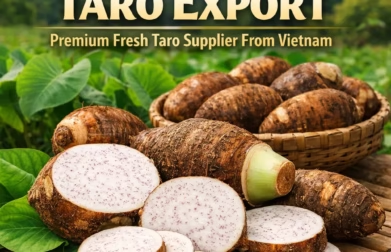
If you are looking for a premium fresh taro supplier from Vietnam with a stable year-round supply, export-grade quality, and competitive pricing, Great Farmer is the reliable partner you can trust.
We fully understand the common concerns of international agricultural importers: pesticide residue levels, risks of spoilage during transportation, inconsistency in size, and the stability of supply. This article provides you with a comprehensive overview of Vietnamese taro and explains why Vietnam Taro Export is becoming a preferred choice in the global market.
1. What Is Taro and Why Is It Gaining Global Popularity?
Taro, also known as taro root (Colocasia esculenta), is a starch-rich root crop widely cultivated in tropical regions such as Vietnam. It is not only a familiar ingredient in Asian cuisine but is also gaining increasing popularity in Europe, the United States, Japan, South Korea, and the Middle East thanks to its naturally nutty flavor, smooth and creamy texture, and high nutritional value.
The global trend toward healthier food consumption has significantly increased the demand for taro in recent years. According to various market insights, taro is not only used in traditional dishes such as soups, stews, and desserts, but is also widely incorporated into processed products such as pastries, snacks, taro powder, bubble tea, and frozen foods.
Vietnam is rapidly emerging as one of the most promising sourcing destinations, thanks to its favorable natural conditions, year-round supply capability, and competitive production costs.
2. Why Is Vietnamese Taro Becoming a Global Sourcing Trend?
In the international market, tens of thousands of tons of taro are traded each year, and Vietnam is steadily increasing its market share thanks to advantages that are difficult to replicate.
The tropical monsoon climate, combined with dense river systems in the Mekong Delta, Red River Delta, and Central Highlands, creates ideal conditions for taro cultivation. Fertile alluvial soil enables Vietnamese taro to develop a uniform round shape, smooth and sticky texture, low fiber content, naturally sweet and nutty flavor, and consistent quality.
In addition, Vietnamese taro stands out for its high starch content and rich nutritional profile, including dietary fiber, potassium, vitamin E, and beneficial micronutrients. These qualities align perfectly with the current global trend toward healthier food consumption.
3. Year-Round Taro Supply Capacity from Vietnam
One of the greatest advantages of Vietnam Taro Export is its ability to supply fresh taro throughout the year.
Thanks to Vietnam’s diverse ecological regions from North to South, taro is cultivated and harvested in staggered seasons, effectively minimizing the risk of supply chain disruptions. When one region experiences unfavorable weather conditions, other key growing areas such as An Giang, Dong Thap, Tra Vinh, Dak Lak, Dong Nai, Tay Ninh, Long An, and Tien Giang can continue to maintain stable production levels.
This advantage enables Vietnam Taro Export to consistently fulfill large-scale contracts, ranging from a few containers to hundreds of containers per month, depending on the specific requirements of each market.
Outstanding Nutritional Value of Fresh Vietnamese Taro
Taro is a naturally nutrient-rich food source. In every 100 grams of fresh taro, it may contain: (1)
| Nutrient | Amount (Per 100g) | % Daily Value (DV) |
|---|---|---|
| Energy | 112 kcal | — |
| Carbohydrates | 26.5 g | 10% |
| Dietary Fiber | 4.1 g | 15% |
| Protein | 1.5 g | 3% |
| Total Fat | 0.2 g | <1% |
| Potassium | 591 mg | 13% |
| Manganese | 0.38 mg | 17% |
| Vitamin B6 | 0.28 mg | 17% |
| Vitamin E | 2.4 mg | 16% |
| Vitamin C | 4.5 mg | 5% |
| Copper | 0.17 mg | 19% |
Thanks to its content of resistant starch, dietary fiber, and essential minerals, Vietnamese taro is considered an agricultural product suitable for a wide range of consumers who are focused on health, balanced diets, and digestive-friendly foods.
4. Health Benefits of Fresh Taro
Fresh taro offers a variety of notable health benefits:
- Supports blood sugar regulation due to its content of dietary fiber and resistant starch. (2)
- Promotes digestive health thanks to its soluble fiber content. (3)
- Supports cardiovascular health and healthy blood pressure due to its high levels of dietary fiber and resistant starch. (4)
- May provide anti-cancer properties due to the presence of polyphenols, particularly quercetin, which has been shown in in-vitro and animal studies to inhibit the growth of certain cancer cells.(5)
- Contributes to cellular protection, immune support, and overall nutritional balance, making it a valuable addition to daily diets.
For these reasons, taro is not only a versatile ingredient for food processing but also a product with significant commercial value and strong health benefits.
5. Why Does Vietnamese Taro Stand Out Compared to Other Sources?
Compared to many other producing countries, Vietnam offers several clear competitive advantages:
- A tropical monsoon climate that is highly suitable for taro cultivation.
- Nutrient-rich alluvial soil that supports uniform root development and consistent quality.
- Long-standing traditional farming experience, ensuring stable cultivation practices.
- Reasonable production costs, enabling competitive export pricing.
- A short supply chain, which helps maintain freshness and reduce post-harvest losses.
- Compliance with international cultivation standards, such as VietGAP and GlobalGAP.
Thanks to these favorable conditions, Vietnamese taro typically features a fine, smooth, and sticky texture with a naturally aromatic flavor, making it well-suited to meet the strict quality requirements of demanding international markets.
6. Vietnam Taro Export – A Premium Fresh Taro Supplier from Vietnam
As a professional exporter, Vietnam Taro Export takes pride in operating standardized growing regions, maintaining a strict quality control team, and ensuring a stable supply capacity.
We manage the entire supply chain from seed selection, cultivation, harvesting, and preliminary processing to storage, packaging, and transportation. Our team carefully selects high-quality taro varieties, including:
- Creamy White-Flesh Taro
- Purple-Flesh Taro
- Baby Taro (Satoimo)
- Large Taro (Colocasia esculenta)
Each shipment is fully traceable, ensuring food safety, product uniformity, and export-grade quality.
7. Main Export Varieties of Vietnamese Taro
Vietnam Taro Export offers a wide range of product lines to meet the diverse requirements of different markets.
7.1. Baby Taro (Satoimo)
This variety features small-sized taro roots, with an average weight ranging from 30g to 80g per root, making it highly suitable for the Japanese, Korean, and other East Asian markets.
Key characteristics:
- Small and uniform size
- Sticky, smooth, and nutty texture
- Ideal for soups, stews, and traditional dishes
- Available with skin-on or peeled, depending on customer requirements
7.2. Large Taro (Colocasia esculenta)
This variety typically weighs from 300g to over 1kg per root, making it well-suited for the food processing industry, including snack production, taro powder, confectionery, and frozen food manufacturing.
Key characteristics:
- Large roots with an attractive shape
- White flesh or purple-marbled interior
- Aromatic flavor with a fluffy texture when cooked
- Suitable for markets such as the United States, EU, and Middle East
7.3. Fresh Whole Taro
This is the most commonly exported product line for importers who require fresh raw materials for distribution or further processing.
7.4. Sliced Fresh Taro
This product is peeled and uniformly sliced, making it suitable for markets that require pre-processed ingredients, such as the Middle East and Taiwan.
7.5. IQF Frozen Taro
Taro is rapidly frozen at low temperatures using the IQF (Individual Quick Freezing) method, extending shelf life and making it suitable for long-distance markets such as the United States and Europe.
7.6. Purple-Flesh Taro
This variety is rich in anthocyanins, making it particularly suitable for markets that prefer visually appealing foods with enhanced nutritional value.
7.7. Vietnam Taro Export Technical Specifications Table
| Criteria | Baby Taro (Satoimo) | Large Taro (Colocasia esculenta) |
|---|---|---|
| Size | S: 30–40g, M: 40–60g, L: 60–80g | 300g–500g, 500g–800g, >800g |
| Shape | Uniform round or oval shape, free from deformation | Long cylindrical or large oval shape |
| Skin Surface | Skin-on with natural hairs or cleaned/peeled surface | Thin skin retained, soil thoroughly cleaned |
| Flesh Color | Opaque white with sticky texture | White flesh with purple marbling, floury texture |
| Storage Temperature | 5°C – 8°C | 5°C – 8°C |
| Humidity | 85% – 90% | 85% – 90% |
| Certifications | VietGAP, GlobalGAP, Phytosanitary Certificate | VietGAP, GlobalGAP, Phytosanitary Certificate |
| Shelf Life | Up to 45 days (under cold storage conditions) | Up to 60 days (under cold storage conditions) |
This specification table serves as a reference for customers to verify product quality, grading standards, and contractual requirements prior to shipment.
8. Integrated Production Process – From Farm to International Customers
To ensure consistent product quality, Vietnam Taro Export implements strict control procedures based on a Farm-to-Table model and a fully managed cold chain supply system.
8.1. Seed Selection and Cultivation
Disease-free planting materials are carefully selected to suit each growing region and local climate conditions.
8.2. Standardized Crop Management
Organic fertilizers are applied, chemical pesticide use is minimized, and detailed farming records are maintained throughout the cultivation process.
8.3. Harvesting
Harvesting is carried out manually when taro roots reach the required standard size, typically ranging from 300–800g per root, or according to specific market requirements.
8.4. Cleaning and Grading
Taro roots are thoroughly washed to remove soil and impurities. Surface treatment is conducted, followed by grading through automated inspection systems to remove damaged, defective, or incorrectly sized roots.
8.5. Cold Storage
Rapid cooling is performed at temperatures ranging from 4–7°C, or according to specific order standards, to preserve freshness and reduce spoilage.
8.6. Packaging and Transportation
Products are packed using carton boxes, mesh bags, vacuum packaging, or customized packaging formats, then transported in refrigerated containers to ensure product quality throughout the shipping journey.
9. Advanced Post-Harvest Processing Technology
Taro is an agricultural product with high latex content and moisture levels. Therefore, improper handling may lead to rot, mold development, or quality deterioration during transportation.
Immediately after harvesting, taro roots are transported to the packing house for the following processes:
- Removal of soil and mud using compressed air systems and automatic brushing equipment
- Grading using optical scanning machines
- Removal of damaged, defective, or incorrectly sized roots
- Drying and surface sanitation
- Preparation for the packaging stage
This process helps maintain the attractive appearance of taro, reduces complaint rates, and enhances reliability with importers.
10. Optimized Packaging Standards and Logistics Solutions
10.1. International Standard Packaging
Depending on market requirements and customer preferences, taro can be packed in various formats:
- Mesh bags: 5kg, 10kg, or 20kg
- Carton boxes: 10kg or 20kg
- Vacuum packaging
- Customized packaging for supermarkets or food processing factories
Packaging materials must ensure proper ventilation, minimize moisture condensation, and reduce physical damage during transportation.
10.2. Transportation by Refrigerated Containers (Reefer Containers)
To maintain taro quality during long-distance shipping, the use of refrigerated containers (reefer containers) is essential.
Typical operating parameters include:
- Temperature: 5°C – 8°C
- Humidity: 85% – 90%
- Ventilation: 15–25 CBM/hour
- Installation of data loggers to monitor temperature and humidity throughout the shipping journey
As a result, taro can reach customers in stable condition, minimizing premature ripening, sprouting, or spoilage.
11. International Certifications – Commitment to Export Quality
Vietnam Taro Export places food safety standards and international compliance at the highest priority. We meet essential certifications and export documentation requirements, including:
- HACCP
- ISO 22000:2018
- GlobalGAP
- VietGAP
- Phytosanitary Certificate
- CO (Certificate of Origin)
- Pesticide Residue Testing
- Full Traceability System
These certifications enable smoother customs clearance, enhance partner confidence, and ensure compliance with strict market requirements such as those in the EU, United States, Japan, and South Korea.
12. Key Export Markets of Vietnam Taro Export
Vietnamese taro is currently widely distributed across multiple regions worldwide.
Japan and South Korea: These markets strongly prefer baby taro and high-quality pre-processed products. They maintain strict requirements regarding size, appearance, and uniformity but are willing to pay premium prices for products that meet their standards.
United States and EU: These markets show strong demand for large taro, particularly for use in the F&B industry, snack production, bakery manufacturing, and frozen food processing.
Middle East: Countries such as the UAE and Saudi Arabia are increasingly favoring Vietnamese taro due to its competitive pricing, stable quality, and flexible supply capacity.
Other Markets: Vietnam Taro Export is also expanding into additional countries and territories such as Taiwan, China, and other Asian regions.
13. Benefits of Choosing Great Farmer as Your Partner
Partnering with Vietnam Taro Export provides a range of practical business advantages:
- Stable year-round supply
- Competitive pricing
- Consistent product quality
- Flexible logistics support
- Free consultation on product specifications and documentation
- Quality assurance according to contractual agreements
- Support for FOB, CIF, and CNF shipping terms based on customer requirements
- Improved profitability through optimized supply chain solutions
These values help customers not only secure high-quality products but also optimize import costs and strengthen their overall business performance.
Conclusion
Great Farmer is not only a supplier of fresh taro but also a reliable export partner for businesses seeking a stable supply, premium quality, and long-term commercial value.
With advantages in favorable natural conditions, standardized growing regions, strict quality control processes, a diverse product portfolio, and professional logistics capabilities, Vietnamese taro is increasingly strengthening its position on the global agricultural map.
If you are looking for a Premium Fresh Taro Supplier from Vietnam, now is the right time to establish cooperation and unlock the vast potential of this growing market.
 Blog & News