In 2023 and early 2024, Vietnam’s fruit and vegetable export turnover continuously broke historical records, surpassing the USD 5 billion milestone. This remarkable figure underscores the strong position of Vietnamese agricultural products on the global trade map. Advantages such as a tropical monsoon climate, diverse soils ranging from the Mekong Delta to the Central Highlands, combined with a series of new-generation Free Trade Agreements (FTAs), have created a powerful springboard for domestic fruits to reach international markets. At the same time, phytosanitary barriers are gradually being removed, opening up direct access to billions of global consumers.
However, the export race is not equally favorable for all crops.
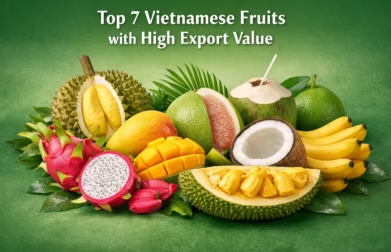
Only a select group of fruits that meet three key criteria abundant supply, internationally compliant quality standards, and strong global demand can secure a place among the highest-value export commodities. Identifying these key products enables exporters to optimize their supply chains and maximize profit margins. So, which Vietnamese fruits currently dominate the country’s export portfolio?
1. In-Depth Exploration: Top 7 Vietnamese Fruits with High Export Value
1.1. Durian – The “King of Fruits” Generating Billion-Dollar Revenue
” Nearly USD 4 billion in export value is the impressive figure that durian is projected to bring to Vietnam in 2025, accounting for almost half of the country’s total fruit and vegetable export turnover.” (1)
It is undeniable that durian has emerged as the brightest star in Vietnam’s fruit export landscape today. This remarkable surge began when Vietnam officially signed the protocol allowing the export of fresh durian through official channels to the Chinese market. With the advantage of geographical proximity, shorter transit times enable Vietnamese durians to retain superior freshness compared to regional competitors.
International markets particularly China with its population of over a billion are experiencing a strong and growing demand for high-quality durian.
Key durian varieties such as Ri6, Monthong, and Dona, cultivated in the Central Highlands, Southeast region, and the Mekong Delta, are being actively sought after by traders. Beyond fresh fruit exports, businesses are increasingly investing in frozen durian and processed durian segments to penetrate high-end markets such as the United States, Japan, and Europe, where consumers are willing to pay premium prices. This shift from raw exports to value-added processing is opening up a highly promising future for the industry. However, durian is not the only fruit capable of generating substantial foreign exchange revenue.
1.2. Dragon Fruit – The Former King with a Strong and Stable Position
” Before the rapid rise of durian, dragon fruit was once Vietnam’s “export king,” with annual export turnover consistently exceeding USD 1 billion during the 2014–2018 period, peaking at around USD 1.3 billion.” (2)
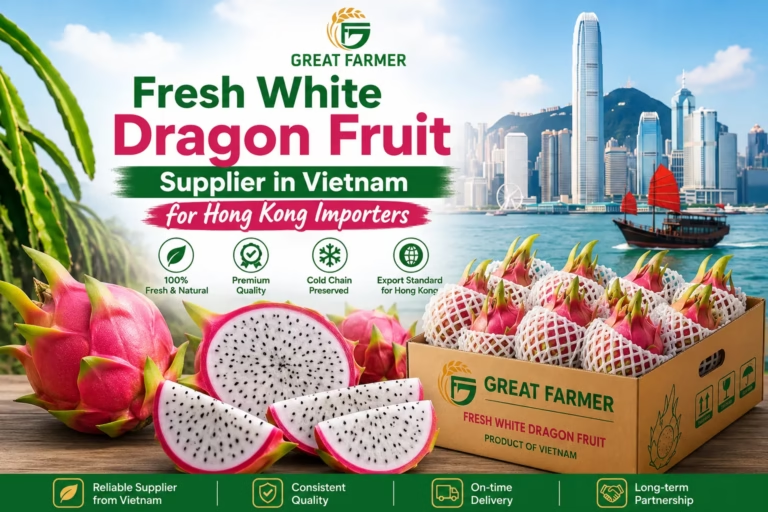
Although it has relinquished its top position, dragon fruit remains firmly listed among the Top 7 Vietnamese Fruits with High Export Value. This fruit enjoys strong global recognition thanks to its striking appearance and excellent nutritional profile. Major growing regions such as Binh Thuan, Long An, and Tien Giang have widely adopted GlobalGAP and VietGAP standards, ensuring compliance with the most stringent food safety requirements. One of dragon fruit’s key advantages is its off-season production capability and relatively long shelf life during sea freight transportation.
Currently, Vietnamese dragon fruit is exported to more than 40 countries and territories. Beyond traditional markets, it is increasingly gaining shelf space in premium supermarkets across Australia, New Zealand, and the United Kingdom. Western consumers, in particular, show strong preference for red-fleshed dragon fruit due to its high antioxidant content, aligning well with the growing demand for healthy and clean eating.
And when it comes to consistency in everyday consumer demand, the next fruit is impossible to overlook.
1.3. Banana – A Competitive Edge Through Year-Round Supply
“Bananas are among Vietnam’s most stable export commodities, with annual production reaching millions of tons and consistently strong global demand, sustaining export revenues of hundreds of millions of USD each year.” (3)
What makes bananas a commercial powerhouse within the Vietnamese fruit category is their year-round harvest capability. Unlike seasonal fruits such as lychee or longan, bananas provide exporters with a steady and reliable revenue stream. Cavendish bananas, propagated through tissue culture and cultivated on large-scale plantations in provinces such as Dong Nai and Hung Yen, have proven highly effective in meeting strict requirements for uniform size, appearance, and taste.
Japan, South Korea, and China represent three “golden markets” for Vietnamese bananas.
These markets impose rigorous standards on product appearance: bananas must have smooth skin, be free from defects, exhibit an ideal curvature, and meet specific sugar content levels. Thanks to advancements in cold chain logistics and increasingly standardized post-harvest packaging processes, Vietnamese bananas are gradually outperforming competitors from Latin America (due to lower logistics costs) as well as the Philippines in the Northeast Asian market.
However, while bananas represent stability, the next fruit stands out for its remarkable growth momentum.
1.4. Jackfruit – A Remarkable Rise
“Jackfruit is rapidly emerging as one of Vietnam’s fastest-growing fruit exports, recording double-digit growth within a short period and gradually becoming a “golden goose” for the industry.” (4)
Thai early-ripening jackfruit and red-fleshed jackfruit varieties are delivering exceptionally high economic returns, particularly in the Mekong Delta and Southwest regions. With advantages such as ease of cultivation, low susceptibility to pests, and high yields, jackfruit is making a significant contribution to the expansion of Vietnamese fruit exports in the global market.
The primary driver behind this growth is the massive demand from the Chinese market.
Consumers in the neighboring country highly favor the rich sweetness and firm texture of Vietnamese jackfruit. Moreover, jackfruit is not only exported as fresh whole fruit but is also increasingly used in value-added processing industries, including dried jackfruit, soft-dried jackfruit, and ingredients for snack production. This diversification has significantly extended the product’s commercial lifecycle.
Shifting from large-sized fruits, we now move to a category that demands a high level of precision in both cultivation and logistics.
1.5. Mango – A Premium Tropical Delight
“ Vietnamese fresh mangoes have successfully penetrated demanding markets such as the United States, Japan, and Australia clear evidence of their premium quality, compliance with strict standards, and growing reputation in the global marketplace.” (5)
Mango rightfully earns its place among the Top 7 Vietnamese Fruits with High Export Value thanks to its unique biodiversity. Vietnam is home to distinctive mango varieties with unparalleled flavor profiles, such as Cat Hoa Loc (fragrant, smooth-textured, and delicately sweet) and Cat Chu. Gaining access to high-end markets requires strict application of Vapor Heat Treatment (VHT) processes to eliminate fruit flies without compromising fruit quality.
The current export strategy for mango focuses on premium market positioning.
Rather than competing on volume, Vietnamese mangoes stand out through their exceptional taste. In supermarkets across the United States and Europe, Cat Hoa Loc mangoes are often sold at premium prices, yet remain in high demand among discerning consumers who appreciate authentic tropical flavors. At the same time, processed products such as soft-dried mango are becoming key export items, generating significant added value for businesses.
Following mango in the premium segment, we move to a citrus category with virtually limitless growth potential.
1.7. Coconut – Explosive Potential from Value-Added Processing
“Vietnam currently ranks among the world’s top five exporters of coconut-based products, with export turnover projected to reach approximately USD 1.1–1.15 billion by 2025, paving the way for even greater billion-dollar milestones.” (6)
Although whole dried coconuts are still exported, the core value that places coconut among the Top 7 Vietnamese Fruits with High Export Value lies in its processed products. Canned coconut water, coconut milk, virgin coconut oil (VCO), and activated carbon from coconut shells are all in high global demand. The rising trend of plant-based consumption and natural electrolyte beverages has pushed coconut demand to record levels.
Ben Tre and Tra Vinh have emerged as key hubs for organic coconut exports.
Enterprises in these regions are heavily investing in advanced automation technologies from Germany and Sweden to produce UHT sterilized coconut water, achieving a shelf life of up to 12 months without preservatives. Major export destinations include North America, Europe, and the Middle East (particularly the UAE). The reopening of markets such as the United States and China for trimmed fresh coconuts (diamond-cut coconuts) further strengthens the position of this commodity.
To provide a clearer and more structured overview, the following strategic data table will help you easily compare these key export fruits.
2. Trade Data Table: Overview of the Top 7 Vietnamese Fruits
Below is a summarized analytical table providing investors and readers with key insights into the export orientation of each fruit category:
| No. | Fruit (Vietnamese) | English Name | Key Growing Regions | Main Export Markets | Common Export Forms | Core Competitive Advantages |
|---|---|---|---|---|---|---|
| 1 | Sầu Riêng | Durian | Central Highlands, Mekong Delta | China, USA, Japan | Fresh whole fruit, frozen pulp | Proximity to China, premium flesh quality, rich and creamy taste |
| 2 | Thanh Long | Dragon Fruit | Binh Thuan, Long An | China, South Korea, Australia, EU | Fresh fruit | High production volume, attractive appearance, rich in antioxidants |
| 3 | Chuối | Banana | Dong Nai, Hung Yen | China, Japan, South Korea | Fresh fruit (Cavendish standard) | Year-round harvest, standardized tissue culture production |
| 4 | Mít | Jackfruit | Mekong Delta, Southwest Region | China, EU | Fresh fruit, dried (crispy & soft-dried) | Competitive pricing, high yield, strong and distinctive flavor |
| 5 | Xoài | Mango | Dong Thap, Son La | USA, Australia, Japan, South Korea, Russia | Fresh (VHT-treated), dried | Unique varieties (Cat Hoa Loc), naturally high sweetness |
| 6 | Bưởi | Pomelo | Ben Tre, Vinh Long | USA, EU, New Zealand | Fresh whole fruit | Thick rind ideal for sea freight, long shelf life |
| 7 | Dừa | Coconut | Ben Tre, Tra Vinh | USA, EU, Middle East, China | UHT coconut water, trimmed fresh coconut | Strong alignment with plant-based trends, advanced processing capabilities |
The table above clearly illustrates the distinct advantages of each fruit category. However, for these products to truly obtain a “passport” to enter global markets, having high production volume and excellent taste alone is not enough.
Behind every container shipment filled with agricultural products lies an exceptionally rigorous quality control system one that must be thoroughly understood and strictly adhered to.
3. Decoding the “Gold Standard” Framework for Vietnamese Fruits to Reach Global Markets
No category of Vietnamese fruits can penetrate premium markets without meeting mandatory international certifications.
In modern agricultural trade, credibility is quantified through verified documentation. To be part of the Top 7 Vietnamese Fruits with High Export Value, every stage from planting and fertilization to harvesting and packaging must be electronically monitored and fully traceable, often enabled through simple QR code scanning.
The first and most critical requirement is the Production Unit Code (PUC).
This growing area code is a prerequisite imposed by key markets such as China, the United States, and Japan. It ensures that fruits are cultivated in strictly controlled zones with regulated pesticide residues and no use of prohibited chemicals. In parallel, GlobalGAP (Good Agricultural Practices) certification serves as a “passport of trust,” allowing Vietnamese fruits to confidently enter the shelves of major supermarket chains across Europe and North America.
Once the fruit is harvested, post-harvest treatment becomes the decisive factor for shipment viability.
Technologies such as irradiation or Vapor Heat Treatment (VHT) are mandatory for many fruits exported to markets like the United States and Australia, eliminating pest and insect risks entirely. In addition, packing facilities must comply with standards such as ISO 22000 or HACCP, ensuring sterile environments, rapid cooling processes, and the use of environmentally friendly packaging materials.
When all these standards are fully met, the value of Vietnamese fruits continues to rise significantly. The question now is: how will this billion-dollar export landscape evolve in the years ahead?
4. Strategic Vision: Where Is Vietnamese Agriculture Heading?
Shifting from “volume-driven exports” to “value optimization” is the guiding principle for the next phase of Vietnam’s fruit industry.
Overreliance on fresh fruit exports carries significant risks in terms of logistics and price volatility. Therefore, the future of Vietnamese fruits will inevitably revolve around the axis of deep processing. Investments in extraction plants, freeze-drying technology, jam production, and concentrated juice manufacturing not only help absorb surplus seasonal output but also generate profit margins that are 3 to 5 times higher than those of fresh fruit exports.
Alongside processing, branding has become a top strategic priority.
Vietnam can no longer remain an anonymous supplier of raw agricultural products. Businesses are increasingly focusing on packaging design that reflects national identity and on storytelling that highlights the rich agricultural heritage behind each product. A Ri6 durian or a box of Cat Hoa Loc mangoes bearing certified origin labels can significantly elevate the perceived value of Vietnamese produce in the eyes of global consumers.
Finally, green agriculture and sustainable development are indispensable pillars for the future.
Global consumers are paying increasing attention to the carbon footprint of the food they consume. The adoption of circular economy practices such as utilizing agricultural by-products (e.g., durian shells for organic fertilizer, coconut fiber for materials)—along with reduced chemical usage, will become the most powerful competitive advantage for Vietnam’s agricultural sector, ensuring its resilience and leadership in the decades to come.
Conclusion: The Pride of Vietnamese Agriculture
The international market is vast yet highly competitive, and the fruits featured in the Top 7 Vietnamese Fruits with High Export Value stand as strong proof of the resilience and exceptional quality of Vietnam’s agricultural products. From the remarkable rise of durian and the solid position of dragon fruit and banana, to the refined appeal of mango, pomelo, jackfruit, and coconut, all are collectively shaping a vibrant, billion-dollar export landscape.
Great Farmer: A Strategic Partner Elevating the Value of Vietnamese Agriculture
More than ever, the billion-dollar game of agricultural exports is not meant for those who go alone and Great Farmer stands as a powerful launchpad to bring your fruit brand to the global stage. Positioned as a pioneer in the agricultural supply chain and export sector, Great Farmer is not merely a trading company, but a “bridge builder” connecting Vietnam’s key fruit-growing regions with the world’s most demanding markets.
We possess in-depth expertise in navigating technical barriers from GlobalGAP standards and Production Unit Code (PUC) requirements to advanced post-harvest treatments such as Vapor Heat Treatment (VHT) and cold-chain packaging solutions for durian, mango, and dragon fruit. By maintaining strict quality control from farm to final destination, Great Farmer optimizes logistics costs while minimizing the risk of product loss or damage.
Credibility, transparency, and the ability to supply large volumes year-round are the “golden guarantees” that have earned Great Farmer the trust of importers across the United States, the EU, Japan, and China.
Don’t let export barriers hold your products back from reaching the world! Whether you are a grower seeking stable, high-value market access, or an international partner looking for a reliable source of premium Vietnamese agricultural products, contact Great Farmer today to receive comprehensive export solutions and the most effective market entry strategies.
Contact us:
📞 Phone/WhatsApp: +84 836314437
📧 Email: hoang.nguyen@greatfarmer.com.vn
🌐 Website: www.greatfarmer.com.vn
 Blog & News