In the global agricultural market, Round Pumpkin has become one of the key export commodities due to its stable consumption demand and high nutritional value. For importers, supermarket chains, and food processing companies, understanding the technical specifications, quality classification, and packaging standards is crucial to ensuring both profitability and brand reputation.
The following article provides a comprehensive overview of the export standards for Round Pumpkin, offering B2B partners a solid basis for evaluating and selecting optimal supply sources.
1. Why is Round Pumpkin preferred in the international market?
Not only a symbol of Western festivals, Round Pumpkin is also considered a “superfood” in the clean food industry. With its thick flesh, naturally sweet taste, and long shelf-life, this agricultural product is particularly suitable for long-distance sea transportation.
Demanding markets such as Japan, South Korea, the EU, and the Middle East impose strict requirements on pesticide residues (MRLs) and product appearance. Therefore, compliance with Round Pumpkin export standards is mandatory for any supplier wishing to participate in the global supply chain.
Note for importers: Choosing Round Pumpkin from GlobalGAP-certified growing regions not only minimizes quarantine risks but also increases commercial value at the retail level.
2. Standard Specifications
To ensure consistency in export shipments, Round Pumpkin must comply with strict technical specifications regarding size, weight, and external characteristics. The following is a set of general specifications widely accepted in Asian and European markets.
2.1. Physical Characteristics
-
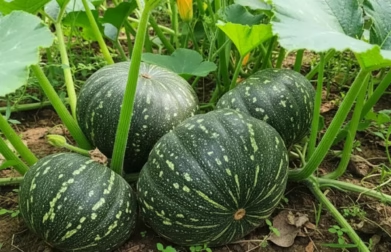
Shape: Uniformly round or slightly flattened round, depending on the variety (e.g., Kabocha or Halloween pumpkin).
-
Skin/Rind: Hard, thick, and free from mechanical damage. Common colors are dark green or orange, sometimes with stripes.
-
Flesh: Bright yellow to deep orange, firm in texture, not spongy or watery.
-
Stem: The stem should be neatly trimmed and dry to prevent mold infestation. Standard stem length is usually 1–2 cm.
2.2. Technical Specifications Table
| Criteria | Specification | Notes |
|---|---|---|
| Product Name | Round Pumpkin | Fresh Round Pumpkin |
| Variety | Japanese Pumpkin (Kabocha), Grey Pumpkin, etc. | Depending on customer requirements |
| Weight | Size S: 0.8 kg – 1.2 kg
Size M: 1.3 kg – 1.8 kg Size L: 1.9 kg – 2.5 kg |
Size M and L are most preferred for export |
| Color | Dark green or orange skin, yellow flesh | Color must be uniform on at least 90% of the surface |
| Maturity | 80% – 90% | Ensures firmness for long-distance transportation |
| Taste | Naturally sweet, firm & nutty | Characteristic of high-quality varieties |
| Origin | Vietnam | Specialized cultivation regions |
3. Quality Grades
In B2B trade, transparency in quality grading helps build trust between buyers and sellers. Round Pumpkin is typically classified into three main grades:
Grade A (Premium Class)
This is the premium grade, typically exported to retail chains:
-
Requirements: Perfectly round fruit, clean skin, free from scars, sunscald, and soil residues.
-
Usage: Displayed whole for retail sale in supermarkets.
Grade B (Standard Class)
This grade maintains internal quality but may have minor external imperfections.
-
Requirements: Small healed scars (under 2 cm²) are allowed; shape may be slightly irregular but does not affect the flesh inside.
-
Usage: Sold at wholesale markets or in lower-priced market segments.
Grade C (Processing Class)
This grade is specifically intended for the food processing industry.
-
Requirements: External appearance is not important; large scars or irregular shapes are allowed, but internal decay or damage is strictly prohibited.
-
Usage: Used for pumpkin powder, canned soups, and pie fillings.
Expert Recommendation: For sea shipment export contracts, we recommend using only carefully selected Grade A and Grade B pumpkins to ensure a wastage rate below 3% upon arrival at the destination port.
4. Packing & Logistics
Packaging is the most important step to protect Round Pumpkin from impact and spoilage due to moisture. Current standard international packing methods include:
4.1. Packing Methods
-
-
Mesh Bags: The most common method due to low cost and high breathability. Typically packed in 10 kg, 15 kg, or 20 kg per bag.
-
Carton Boxes: Used for premium segments (Grade A). Provides better protection for the pumpkin skin and enhances display aesthetics. Carton boxes should have ventilation holes.
-
Bins (Large Wooden Crates): Intended for bulk buyers who will repack locally.
-
4.2. Storage & Shipping Conditions
To maintain the freshness of Round Pumpkin during a 15–30 day sea journey, the refrigerated container (Reefer Container) must be set to optimal conditions:
| Parameter | Value | Explanation |
|---|---|---|
| Temperature | 10°C – 12°C (50°F – 54°F) | Temperatures below 10°C may cause chilling injury. |
| Humidity | 70% – 75% | Too high humidity promotes mold growth; too low causes dehydration (skin shriveling). |
| Ventilation | 25 – 30 CBM/h | Necessary to remove ethylene gas and respiratory heat. |
| Loading Capacity | 24 – 28 tons / 40′ RF container | Depends on the packing method (Mesh Bags or Carton Boxes). |
5. Sanitary & Phytosanitary
To import Round Pumpkin into major international markets, the product must comply with the following technical requirements:
-
Phytosanitary Certificate: Certification confirming that the shipment is free from prohibited pests and diseases, such as fruit flies and mealybugs.
-
Pesticide Residues: Strict compliance with the importer’s Maximum Residue Limits (MRLs) for approved plant protection chemicals.
-
Traceability: Growing Area Code (PUC) and Packing House Code (PHC) are mandatory for markets such as China, Australia, and the United States to ensure full traceability throughout the supply chain.
-
Additional Certifications: Certifications such as GlobalGAP, HACCP, and ISO 22000 provide strong competitive advantages and enhance market access.
6. GREAT FARMER – Benefits of Partnering with a Reputable Supplier (Why Partner with Us?)
In the context of a volatile global supply chain, finding a stable source of Round Pumpkin can be challenging. Great Farmer, as a professional supplier, offers you:
-
Year-round stable supply: Thanks to our extensive network of growing regions.
-
Strict quality control (QC): Three-step inspection process (At the farm – At the packing warehouse – Before loading into the container).
-
Competitive pricing: Direct sourcing from farm to export, optimizing logistics costs.
-
OEM services: Support for customized packaging under the customer’s own brand.
Conclusion
Round Pumpkin is a high-potential agricultural product with continuously growing market demand. However, to succeed in this sector, understanding and complying with standards on specifications, grading, and export procedures is essential.
If you are an importer looking for high-quality, export-standard Round Pumpkin at the best prices from Vietnam, contact us now for a detailed quotation and consultation.
Secure your premium Round Pumpkin supply from Vietnam today!
Contact us for quotes and personalized export solutions.
📞Phone/Whatsapp:+(84) 785017575 | +(84) 778078134 |+(84) 0335313567
📧Email: mia@greatfarmer.com.vn | clay@greatfarmer.com.vn | loan@greatfarmer.com.vn
🌐Website: www.greatfarmer.com.vn
 Blog & News