In the tropical fruit segment, pineapple has always been among the top tropical fruits in terms of trading volume. However, not all pineapple varieties deliver optimal economic returns for wholesalers and importers. The emergence of the MD2 pineapple has truly revolutionized the industry, completely changing the game in the agricultural sector. If there were a name crowned as the “king of pineapples” for commercial and export purposes, it would undoubtedly be the MD2 pineapple. For importers, distributors, and large-scale retail chains, the MD2 pineapple is not merely an agricultural product; it is a solution that optimizes the supply chain, minimizes spoilage risks, and increases the loyalty of end consumers.
For an importer in Asia, Europe, or the Middle East, choosing MD2 pineapples is not just about filling the shelves it is about selecting a business asset with low risk and high capital turnover. This article delves into why MD2 pineapples have become the top choice in international agricultural procurement contracts and how they effectively solve the economic challenges for B2B businesses.
1. MD2 Pineapple: A Legacy of Science and Commercial Ambition
1.1. Origin and Development History
The MD2 pineapple is not a variety that was discovered by chance in nature. It is the result of a decades-long, highly rigorous selective breeding program conducted by the Pineapple Research Institute (PRI) in Hawaii, designated as 73-144.
In the 1980s, Del Monte Corporation recognized the enormous potential of the 73-144 line and began trial cultivation in Costa Rica. By 1996, it was officially launched on the market under the name MD2, introduced by Del Monte. It immediately transformed the global fresh pineapple consumption standard and replaced the Smooth Cayenne variety which had been the world standard at the time thanks to its excellent resistance to sea transport.
Subsequently, MD2 gradually replaced older pineapple varieties such as Smooth Cayenne and Queen due to its superior flavor and physical characteristics. This pineapple variety is a combination of the best traits from multiple different pineapple lines.
1.2. Why Is It Called the “Golden Standard”?
The name “Golden Pineapple” does not only refer to its golden-yellow peel when ripe but also signifies its economic value. In the agricultural industry, “gold” means:
-
Consistent quality: Each batch of 1,000 fruits is uniform in size and sweetness.
-
Extremely low spoilage rate: Strong resistance to core rot and good impact tolerance.
-
High consumer preference: Shoppers are willing to pay a premium for a pineapple that does not irritate the tongue.
2. Botanical Characteristics and Agronomic Advantages of MD2 Pineapple
To understand why MD2 generates high profits, distributors need to understand how it is cultivated.
2.1. Morphological Structure
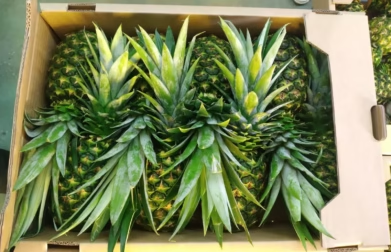
The MD2 pineapple has a perfectly cylindrical shape, without unusual narrowing or bulging. This optimizes packing into cartons.
-
Leaves: The most important feature is that the leaves are spineless (or have very few spines). This significantly reduces mechanical damage to the fruit during harvest and increases worker efficiency.
-
Eyes: The eyes of MD2 pineapples are large, shallow, and flat. During industrial processing or supermarket peeling, fruit loss is minimal (only about 15–20% compared to 30–35% for other pineapple varieties).
-
Color: When ripe, the peel turns a bright, attractive yellow (Gold), and the flesh is deep yellow and juicy.
-
Flavor: High Brix (sweetness) and low acidity create a clean, sweet aftertaste without causing tongue irritation a key factor for dominating Western markets.
2.2. Adaptability and Growth Cycle
The MD2 pineapple requires more advanced cultivation techniques than the Queen or Cayenne varieties. It needs well-drained soil and an appropriate pH level.
-
Growth period: From planting to harvest, it takes approximately 12–14 months, depending on climatic conditions.
-
Flower induction: MD2 responds very well to ethylene treatment, allowing growers to regulate production according to market demand and ensuring year-round supply for importers.
3. Why MD2 Pineapple Is a “Survival Choice” for B2B Importers
When a wholesaler searches for “MD2 pineapple,” what they are really seeking is not just fruit quality, but risk management and profit margin.
-
Exceptional shelf-life
One of the biggest challenges for fruit importers is the loss rate during sea transport. MD2 pineapples have a sturdy cellular structure and a peel that is thick enough to protect the fruit but not overly hard. Under standard conditions, the shelf life can last 30–35 days, allowing goods to travel across continents while maintaining freshness upon reaching retail shelves.
-
Uniformity – the key to modern retail
For supermarkets, having 100 pineapples of the same size and weight is critically important. MD2 perfectly meets this standard. Consistency helps:
-
Easily pack into cartons according to standard counts (6, 7, 8, or 9 fruits per carton).
-
Optimize storage and display space.
-
Set fixed retail prices per unit without complex weighing or adjustments.
4. Technical Analysis: Standard Parameters for Importers and Comparison with Other Common Pineapple Varieties
For a B2B order, emotions have no place. Everything must be quantified using technical specifications.
Table 1: MD2 Pineapple Quality Standards for Export
| Parameter | Technical Requirement | Notes for Distributors |
|---|---|---|
| Sweetness (Brix) | 14° – 18° | Highest sweetness among commercial pineapple varieties. |
| Acidity (Citric Acid) | 0.4% – 0.5% | Low acidity creates a clean, non-pungent sweetness. |
| Firmness | > 2.5 kg/cm² | Ensures fruit is not crushed during 20–30 days of container transport. |
| Average Weight | 1.3 kg – 2.5 kg | Classified by size: 5, 6, 7, 8, 9, 10 fruits per carton. |
| Core Hollowing | < 5% of cross-sectional area | Dense flesh, not spongy or airy. |
| Color Index | C0 (Green) – C3 (75% Yellow) | Depends on target market and shipping method. |
Meaning of Peel Color Index (Coloring Stage)
Importers should note:
-
C0 – C1: Suitable for sea transport to distant markets (Europe, USA) with transit times over 20 days.
-
C2 – C3: Suitable for road or air transport (nearby markets such as China, Singapore) for immediate sale
Bảng 2 : So Sánh Dứa MD2 Với Các Giống Dứa Phổ Biến
To understand why MD2 accounts for over 80% of the global fresh pineapple market, take a look at the technical comparison table below.
| Comparison Parameter | MD2 Pineapple (Golden Pineapple) | Queen Pineapple (Local/ Cayenne) | Smooth Cayenne Pineapple |
|---|---|---|---|
| Sweetness (Brix) | 14% – 18% (Very high) | 12% – 15% (Moderate) | 13% – 15% (Moderate) |
| Acidity | Low (No tongue irritation) | Medium | High (Can taste sour) |
| Flesh Color | Bright deep yellow | Light yellow | Whitish yellow |
| Shape | Cylindrical, flat eyes | Conical, deep eyes | Large cylinder |
| Shelf Life | 4–5 weeks (Cold storage) | 1–2 weeks | 2–3 weeks |
| Usable Flesh Ratio | >70% (Easy to peel) | <60% (Many eyes) | ~65% |
| Primary Use | Fresh consumption, premium export | Domestic consumption, canning | Industrial processing |
5. Why MD2 Is a “Competitive Weapon”
5.1. Solving the “Wastage Rate” Problem
In the fruit retail industry, profits are often “eaten up” by spoilage (shrinkage). MD2 pineapples have a very sturdy cellular structure. Even when the peel starts turning deep yellow, the flesh inside remains crisp and does not develop internal browning as quickly as other varieties.
5.2. “Mix & Match” Capability in Processing
MD2 is not only sold as fresh fruit. It is the only pineapple variety that can meet diverse channel requirements:
-
Horeca (Hotels/Restaurants): Easy to peel, produces round, attractive slices, and consistent sweetness makes recipe portioning easier for chefs.
-
Fresh-cut (Pre-cut fruit): MD2 does not release much juice after cutting, allowing supermarket pre-cut pineapple trays to maintain visual appeal for 5–7 days.
-
Premium juice: High vitamin C content and naturally bright yellow color, eliminating the need for added coloring.
6. International Standard Harvesting and Post-Harvest Handling Process
A small mistake in post-harvest handling can ruin an entire container of pineapples. B2B customers need to closely monitor the supplier’s process:
6.1. Harvesting at the Right Maturity
MD2 pineapples are harvested based on the number of days after flower induction (usually 150–160 days), not just peel color. Harvesting too early results in bland fruit, while harvesting too late increases the risk of fermentation.
6.2. Process at the Packing House
-
Pre-cooling: This is the most critical step. After being harvested in the field, pineapples are at a high temperature (28–30°C) and need to be cooled down to 10°C within 4–6 hours to slow down respiration.
-
Washing and sanitizing: Low-concentration chlorine water or approved biological agents are used to remove fungi and scale insects.
-
Waxing: A thin layer of food-grade wax is applied to the peel to prevent moisture loss, enhance shine, and improve shelf appeal in supermarkets.
-
Automated sorting: Sensor systems are used to sort pineapples by weight accurately, ensuring 100% uniformity in every carton.
7. Logistics: The Lifeline of the MD2 Pineapple Export Industry
For wholesale distributors, logistics is a critical factor that determines cost (CNF/CIF).
7.1. Standard Packaging Structure
-
Cartons: Must be high-strength (5–7 layers) with a water-resistant coating to prevent softening in cold storage conditions.
-
Arrangement: Pineapples are usually placed standing or alternating horizontally to avoid damage to the eyes.
-
Ventilation: Cartons must have ventilation holes aligned with the cold airflow inside the container.
7.2. Cold Chain Management
Any break in the cold chain causes pineapples to “sweat,” creating conditions for mold growth. Professional importers always require a temperature data logger to be placed in each container to monitor conditions throughout the journey.
8. Essential Certifications for a Reputable MD2 Pineapple Supplier
To ensure long-term success in the B2B agricultural industry, importers need to review the supplier’s credentials, including:
-
GlobalGAP: Global Good Agricultural Practice standard.
-
HACCP / ISO 22000: Food safety management system certification at the packing house.
-
Phytosanitary Certificate: Plant quarantine certificate (mandatory for export).
-
Certificate of Origin (C/O): Certificate of origin to qualify for preferential tariffs (e.g., Form E, Form EUR.1).
9. Vision 2025–2030: The Future of the MD2 Pineapple Industry
The development of biotechnology will soon produce MD2 varieties with improved pest and disease resistance, minimizing the need for chemical treatments. At the same time, traceability through QR codes on each pineapple will become a mandatory standard. Distributors who adopt this technology will earn full consumer trust.
MD2 pineapples are not merely an agricultural product; they are a symbol of professionalization in agriculture. Investing in the MD2 pineapple value chain is the most sustainable way for agri-businesses to build their own empire.
Conclusion: Investing in MD2 Pineapples Is Investing in Stability
Based on the detailed analysis above, it can be affirmed that MD2 pineapples are the optimal solution for every link in the agricultural supply chain, from farmers to importers, and ultimately to consumers. With superior qualities in fruit quality, shelf life, and economic efficiency, MD2 has no rivals in the premium fresh pineapple segment.
For distributors and wholesalers, adding MD2 to their strategic product portfolio not only increases revenue but also reinforces the company’s position as a provider of the finest products in modern agriculture.
If you are looking for a GlobalGAP-certified MD2 pineapple supplier capable of fulfilling large-volume orders with professional logistics, contact us at GREAT FARMER to receive a detailed seasonal report and the most competitive price list.
In-Depth Q&A for B2B Customers
During our market research, we found that buyers often have the following common questions:
Q1: How long can MD2 pineapples be stored in cold storage?
Answer: Under standard conditions (Temperature 7°C–10°C, Humidity 85–90%), MD2 pineapples can maintain commercial quality for up to 35 days. Using a CA container (Controlled Atmosphere), the storage period can extend to 45–50 days. This allows importers from Vietnam to reach distant markets such as Russia or Northern Europe via sea transport.
Q2: How can one distinguish genuine MD2 pineapples from fake or low-quality MD2?
Answer: Genuine MD2 has a thin peel, very large and flat eyes with almost no ridges. When cut in half, the core is small and edible (crisp, not fibrous). The aroma is distinctive it is not overwhelming at first, but releases a subtle, elegant fragrance when fully ripe.
Q3: What advantages do Vietnamese MD2 pineapples have compared to those from Costa Rica or the Philippines?
Answer:
-
Flavor: Vietnam’s unique soil (especially in Ninh Bình, Thanh Hóa, and Tiền Giang) imparts a deeper, sweeter aftertaste.
-
Cost: Labor and domestic logistics in Vietnam are currently very competitive.
-
Delivery time: For China and ASEAN markets, Vietnamese pineapples benefit from shorter transport times, ensuring fresher fruit for consumers.
Q4: Is MD2 sweeter than honey pineapple?
Answer: MD2 has stable, high sweetness comparable to honey pineapple, but its low acidity makes the sweetness “full” and smooth, without sharpness or mouth irritation, suitable for children and the elderly.
Q5: Why is the price of MD2 often higher than other pineapple varieties?
Answer: The higher price reflects investment in the variety, high-tech cultivation processes, and its commercial value. Low spoilage rates and high sell-through rates ensure distributors earn better net profit compared to cheaper, fast-spoiling varieties.
Q6: How can one identify export-quality MD2 pineapples?
Answer: Look at three key factors:
-
Cylindrical shape (no narrowing at the middle)
-
Flat eyes (almost no sharp spines)
-
Weight (usually 1.3–2.5 kg depending on size)
Notably, the core is small and soft, edible, and non-fibrous.
 Blog & News