In the agricultural commodities world, few fruits possess a product life cycle (PLC) as resilient and versatile as the coconut. In particular, mature coconut (dry coconut) is not merely a food ingredient, but a strategic raw material that serves as the backbone of multiple multi-billion-dollar industries ranging from food processing and cosmetics to biofuels.
For importers, distributors, and wholesale buyers in the B2B agricultural supply chain, the key question is no longer simply “Where can we buy coconuts?” but rather “How can we secure a reliable source of mature coconuts with stable oil content, consistent kernel quality and size, and optimal storage performance that minimizes spoilage risks during long-distance sea transportation?”
The article below delivers a comprehensive and multi-dimensional analysis of the mature coconut market. It provides in-depth market intelligence that enables B2B partners not only to understand the product itself, but also to optimize profitability through informed and strategic sourcing decisions.
1. Technical Definition: What Is Mature Coconut and Its Commercial Distinctions
In international trade terminology, confusion between young coconuts and mature (dry) coconuts can lead to serious and costly errors in purchase orders.
1.1. Mature Coconut – Biological and Commercial Characteristics
In international trade terminology, a mature coconut (dry coconut) refers to a coconut that has reached full physiological maturity, typically at 10–12 months of age. At this stage, the outer husk changes from green to earthy brown or dark brown, the internal water volume decreases while mineral concentration becomes more condensed, and most importantly the coconut meat (kernel) reaches its maximum thickness and hardness.
-
Identification characteristics: A mature coconut has a hard brown shell, and when shaken, produces a distinct sloshing sound due to the reduced water content as space is increasingly occupied by the fully developed coconut meat.
-
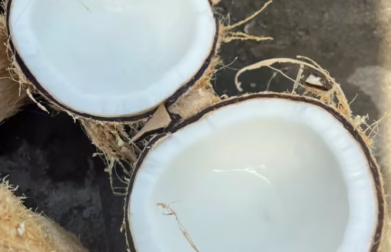
Core value: The coconut meat (kernel) is thick, firm, off-white in color, and contains an exceptionally high oil content. This oil yield is the primary value indicator for manufacturers of coconut oil and desiccated coconut.
Why do importers prioritize mature coconuts over young coconuts?
-
Oil content:
This is the decisive factor. Mature coconuts contain the highest oil concentration, typically 63–65%, making them the premium raw material for producing virgin coconut oil (VCO), canned coconut milk, and desiccated coconut. -
Shelf life: Mature coconuts are protected by a hard shell, providing optimal natural preservation. This allows them to withstand 4–6 weeks of sea freight transportation without significant quality degradation, making them far more suitable for long-distance international shipping.
1.2. Differentiating Mature Coconuts and Young Coconuts
Để tránh nhầm lẫn trong sourcing (tìm nguồn hàng), bảng dưới đây so sánh các chỉ số kỹ thuật quan trọng:
| Criteria | Mature Coconut (Dry Coconut) | Young Coconut |
|---|---|---|
| Age | 10–12 months | 6–8 months |
| Husk Color | Brown, with dried coconut husk | Green, or diamond-cut white (trimmed) |
| Weight | 0.5–1.2 kg (varies by grade) | 1.0–1.5 kg (higher water content) |
| Coconut Meat (Kernel) | Thick, firm, off-white, high oil content | Thin, soft, jelly-like, low oil content |
| B2B Application | Oil extraction, coconut milk, desiccated coconut, confectionery | Direct consumption as a beverage |
| Transportation | Dry container (ventilated) or reefer if required | Mandatory refrigerated container |
For traders and wholesalers, mature coconuts represent a safer investment. The risk of spoilage is significantly lower than that of young coconuts, and the processing margin is considerably broader, offering far greater flexibility and profitability potential.
1.3. Classification of Mature Coconuts in Export Trade
To optimize logistics costs, mature coconuts are commonly processed and exported in two primary forms:
-
Semi-husked Mature Coconut: The outer coconut husk has been mostly removed, leaving only a small portion of fiber around the shell (typically near the “eyes”) for protection. This is the most widely traded format, as it offers an optimal balance between shelf life, protection, and reduced weight.
-
Whole Round Mature Coconut: The coconut is exported with the entire husk intact. This format is typically used for nearby markets or for specific applications where the husk (coir fiber) is also required.
2. Why Vietnamese Mature Coconuts (Ben Tre) Are the Top Choice for Importers
When searching for the keyword “mature coconut”, experienced importers often associate it directly with Ben Tre, Vietnam. This is no coincidence.
2.1. Soil Conditions and Oil Content
Ben Tre is located in the lower Mekong Delta, enriched by nutrient-dense alluvial soil and a unique brackish water ecosystem. These natural conditions create a distinctive coconut kernel structure:
-
Kernel thickness: Significantly thicker than coconuts grown in sandy or upland soils.
-
Fat (oil) content: Exceptionally high (over 65% in dry kernel), enabling maximum extraction efficiency for coconut oil and coconut milk production.
For B2B processors and manufacturers, even a 1–2% increase in oil content can translate into thousands of US dollars in additional profit per container.
2.2. Natural Storage and Durability
Ben Tre mature coconuts feature a thick, hard shell, which provides superior protection against impact during handling, loading, and long-distance sea transportation. This natural durability allows the coconuts to withstand 30–45 days of ocean freight to Europe or North America without cracking, breakage, or quality deterioration.
3. Gold Standard for Export-Grade Mature Coconuts (Vietnam Origin)
Vietnam particularly Ben Tre Province is widely recognized as the country’s coconut capital, with extensive cultivation areas and quality that is highly regarded on the global agricultural map. When importers search for the term “Ben Tre mature coconut”, they are not simply looking for an origin they are seeking a clearly defined quality benchmark.
3.1. Packaging and Grading Specifications
In B2B transactions, consistency is king. Export-grade mature coconuts are typically classified into the following categories:
Grade A – Semi-husked Mature Coconut:
The outer husk is mostly removed, leaving a small portion of fiber to protect the soft eye.
-
Weight: 800–1,200 g per nut
-
Size: Uniform
-
Damage rate: < 3%
Grade B – Full-husked Mature Coconut:
The coconut retains the entire husk. This grade is less common for long-distance exports due to lower container space efficiency.
Grade C – Polished / Bald Mature Coconut:
The coconut is completely de-husked and shell-polished. This grade offers a high-end appearance but requires stricter storage and handling conditions.
3.2 Technical Standards and Classification (Specification Table)
This is the most critical section for procurement teams. Below is a reference specification table for Grade A export-quality mature coconuts:
| Specification | Details | B2B Notes |
|---|---|---|
| Type | Semi-husked Mature Coconut | Easy shell inspection |
| Weight | 0.7–1.2 kg per nut | Uniform size improves packing efficiency |
| Size | Circumference: 35–45 cm | Compatible with automated peeling lines |
| Color | Natural brown, no mold | No harmful bleaching agents used |
| Oil Content | 63–65% (minimum) | Most critical metric for processing yield |
| Moisture | Adjustable (typically natural) | Must be controlled during container transit |
| Sprouting | Max. 1–2% (or 0% upon request) | Sprouted nuts reduce oil yield |
| Packing | Mesh bags, 25–30 nuts per bag | Space-efficient and well-ventilated |
Technical Note: For shipments to strict markets such as the EU, US, and Japan, importers should require additional certifications including GlobalG.A.P., Organic (USDA/EU), as well as HACCP and ISO 22000 for the packing facility.
4. Decoding Market Demand (People Also Ask – PAA Integration)
To better serve our customers, we integrate expert-level answers to the most frequently asked questions about mature coconuts, from both consumer and professional perspectives.
4.1. “Dừa khô để được bao lâu?” (Shelf-life Analysis)
-
Consumer-level answer: Whole mature coconuts can be stored at room temperature for 2–4 months under proper conditions.
-
Answer for importers (B2B): Under logistics storage conditions using a ventilated container (Ventilation mode) at a temperature range of 25–30°C, semi-husked mature coconuts maintain optimal quality for 45–60 days. If a refrigerated container (Reefer) is used at lower temperatures, the shelf life can be extended; however, transportation costs will increase accordingly.
-
Recommendation: Accurate calculation of “transit time” from Cat Lai Port (Ho Chi Minh City) to the destination port is a critical, decision-making factor in selecting the appropriate packaging type.
-
4.2. “How to select high-quality, high-oil mature coconuts?”
-
Key indicator: When shaken, the coconut should produce a clear, sharp sloshing sound. If the sound is dull, heavy, or absent, the coconut may be internally damaged or sprouted, as the coconut embryo absorbs most of the internal water.
-
Shell check: Press a fingernail against the brown shell. If it feels hard and firm, with no soft indentation, the coconut has reached proper maturity and meets quality standards.
4.3. “How much coconut oil can be extracted from 1 kg of mature coconut?”
This is a question directly related to production efficiency (yield).
-
On average, 10–12 mature coconuts equivalent to approximately 3–4 kg of freshly grated coconut meat can produce 1 liter of virgin coconut oil using cold-press or traditional cooking methods.
-
With modern industrial processing lines (Centrifuge / Cold Press systems), oil recovery yield can be significantly higher, thereby optimizing profitability for processing plants.
5. Production Process & Supply Chain
The value of a mature coconut lies not only in the fruit itself, but in the professional handling process that minimizes risk for traders and importers.
Step 1: Harvesting
Coconuts are harvested manually or semi-mechanically once they reach full maturity. In Ben Tre, farmers apply a traditional technique known as “coconut maturity inspection” to accurately determine the optimal harvesting stage.
Step 2: Collection & De-husking
Coconuts are transported by boats or barges to large riverside collection centers. Here, the de-husking process takes place. This is a critical step to remove the bulky outer husk, thereby reducing freight costs and improving container efficiency.
Step 3: Grading & Cleaning
Coconuts are graded by size (S, M, L). Nuts that are cracked, sprouted, or deformed are removed from the export line and redirected for domestic processing such as desiccated coconut or coconut oil production.
Step 4: Packing
The most common B2B export packing formats include:
-
Mesh bags: 20 / 25 / 30 nuts per bag
Advantages: Cost-effective, well-ventilated, and allows buyers to visually inspect the product. -
Carton boxes: Used for premium markets such as the EU, Japan, and South Korea.
Advantages: Superior protection and easy stacking, though at a higher cost.
6. Business Potential: Why B2B Buyers Should Choose Mature Coconuts Now
The global market is experiencing a strong shift toward plant-based products, and mature coconuts are at the core of this transformation.
6.1. Product Portfolio Diversification
From a single imported container of mature coconuts, a processing facility can produce a wide range of high-value products:
-
Coconut Milk / Coconut Cream:
A direct alternative to animal milk, driven by the vegan and plant-based trend. -
Desiccated Coconut / Coconut Powder:
An essential raw material for the bakery and confectionery industry. -
Virgin Coconut Oil (VCO):
A recognized superfood and a premium ingredient for the cosmetics and personal care industry. -
Activated Carbon:
Produced from coconut shell (a by-product of mature coconuts), with exceptionally high economic value in air and water filtration industries.
6.2. Price Stability
Unlike short-season fruits (such as lychee or longan), coconuts are harvested year-round. This allows importers to secure long-term contracts with relatively stable pricing, reducing volatility and enabling reliable financial planning.
7. Critical Considerations When Importing Mature Coconuts
This is the most valuable section for professional buyers—highlighting risks that are often not openly discussed by suppliers.
7.1. Germination Risk
A mature coconut is a living seed. Under conditions of high humidity and warm temperatures inside containers, coconuts may germinate during transit.
Solution: Require suppliers to ensure coconuts are properly placed into a “dormant state”, with the shortest possible time between harvesting and container loading. Strict control of container ventilation is mandatory.
7.2. Shell Cracking
Cracking can occur due to over-stacking or impact during container handling and lifting.
Solution:
Carefully inspect mesh bag specifications. Bags must be tightly packed, and containers should be loaded using a “cross-locking” stacking technique to prevent shifting during transit.
7.3. Export & Import Documentation
Mature coconuts are classified as raw agricultural products, making a Phytosanitary Certificate mandatory. Additionally, depending on the destination market (e.g. European Union), certifications such as GlobalG.A.P. or Organic (EU / USDA) may be required.
Ensure that your Vietnamese supplier has proven experience working with plant quarantine authorities and international inspection agencies
8. Conclusion: Growing Together Through Partnership
The global mature coconut market continues to expand. Selecting a supplier today is no longer about securing the lowest price it is about long-term commitment to quality, consistency, and deep expertise in international logistics.
We understand that behind every import order lies your company’s reputation with downstream distributors and retail partners. A properly graded, export-standard mature coconut is not just a commodity it delivers profitability, operational peace of mind, and faster capital turnover.
If you are seeking a Ben Tre–origin mature coconut supplier that offers export-grade quality, year-round stability, and full transparency across every stage of the process, let GREAT FARMER become a reliable and strategic link in your supply chain.
Contact us:
📞 Phone / WhatsApp: +84 785 017 575 | +84 778 078 134 | +84 033 531 3567
📧 Email: mia@greatfarmer.com.vn | clay@greatfarmer.com.vn | loan@greatfarmer.com.vn
🌐 Website: www.greatfarmer.com.vn
 Blog & News