
1. Overview of Great Farmer Export Markets & Global Fresh Produce Trends
Global demand for agricultural products is experiencing strong growth. Consumers at supermarkets, restaurant chains, and international retail systems are increasingly prioritizing products with clear traceability, premium quality, and compliance with food safety standards. In this context, Vietnam with its tropical climate, fertile soil, and well-developed agricultural sector has established itself as one of the world’s key suppliers of agricultural products.
Recognizing this trend, GREAT Farmer has built its brand as a trusted trading partner, delivering high-quality Vietnamese agricultural products to customers worldwide. Through its Great Farmer Export Markets expansion strategy, the company focuses on developing its export network across several high-potential key markets, including Thailand, the Middle East, Malaysia, Singapore, and Hong Kong.
With a strong network of partnerships with agricultural cooperatives, growing regions, and farmers throughout Vietnam, GREAT Farmer ensures a stable supply, consistent product quality, and the flexibility to meet the specific requirements of each market. At the same time, the company strictly complies with phytosanitary regulations, food safety standards, and the import requirements of each destination country, contributing to enhancing the value and global reputation of Vietnamese agricultural products.
2. GREAT Farmer’s Quality-Oriented Business Model
To expand and achieve sustainable growth across the Great Farmer Export Markets, GREAT Farmer has built its business model on two core pillars: stringent quality control and sustainable partnerships with growing regions. This foundation enables the company to meet strict import standards while maintaining a stable supply for international customers.
2.1 Commitment to Supplying High-Quality Agricultural Products
GREAT Farmer partners with agricultural cooperatives, growing regions, and qualified farmers to carefully select products that meet requirements for quality, consistency, and food safety. Depending on each product category and the specific requirements of the destination market, products are harvested, graded, packed, and stored according to appropriate procedures to preserve their optimal quality throughout transportation.
-
Ensuring Quality and Freshness: Harvesting, post-harvest handling, and storage processes are strictly controlled to preserve the products’ natural flavor, nutritional value, and appearance until they reach customers.
-
Meeting International Standards: Products are carefully monitored from the growing region through the packing stage to comply with the import requirements of each destination market, including phytosanitary regulations, food safety standards, traceability, maximum pesticide residue limits (MRLs), grading, quality specifications, and packaging requirements. Every shipment is prepared in accordance with the applicable technical standards, helping ensure smooth customs clearance while maintaining product quality upon arrival.
- Serving Diverse Customer Segments: From retail chains and supermarkets to importers, distributors, and the HORECA sector across multiple countries, GREAT Farmer consistently provides tailored solutions to meet the specific needs of each business partner.
2.2 Sustainable Partnerships with Agricultural Cooperatives and Farmers
GREAT Farmer has developed a sustainable partnership model with agricultural cooperatives, growing regions, and farmers across multiple provinces in Vietnam to build a stable, transparent supply chain that meets the requirements of international markets:
-
Developing Sustainable Growing Regions: GREAT Farmer collaborates with agricultural cooperatives and farmers in key growing areas, including the Mekong Delta, the Central Highlands, and the Southeast region, to establish a stable supply source, ensure year-round production, and meet the demands of international customers.
-
Quality Control in Compliance with Export Standards: The company works closely with its production partners to implement standards such as VietGAP and GlobalG.A.P., while controlling maximum pesticide residue limits (MRLs), ensuring product traceability, and complying with phytosanitary requirements. These measures help products meet the import regulations of each destination market.
-
Developing a Sustainable Value Chain: This partnership model provides farmers with stable market access, enhances the value of Vietnamese agricultural products, and encourages standardized farming practices. At the same time, GREAT Farmer secures a reliable supply of consistently high-quality products that meet the specific size, color, maturity, and packaging requirements of each export order.
2.3 Quality Control Process from Growing Regions to the Port of Export
To ensure that every shipment meets the standards of international markets, GREAT Farmer implements a comprehensive quality control process from the growing regions through to export. Each stage is closely monitored to maintain product quality, ensure food safety, and comply with the specific import requirements of each destination market.
The quality control process consists of five key steps:
Step 1: Growing Region Assessment
Growing regions and suppliers are carefully selected based on their compliance with quality standards, food safety requirements, and product traceability.
Step 2: Harvesting at the Optimal Time
Products are harvested at the appropriate stage of maturity according to the requirements of each agricultural product and destination export market, ensuring optimal quality throughout transportation.
Step 3: Grading and Post-Harvest Handling
Agricultural products are graded by size and quality, then cleaned, processed, and subjected to appropriate post-harvest treatments to extend shelf life and maintain product quality.
Step 4: Packaging and Storage
Products are packed according to the specifications of each customer and destination market, then stored under appropriate conditions to preserve their quality throughout the transportation process.
Step 5: Final Inspection and Export Documentation
Each shipment undergoes a final inspection before export, and all required documentation is prepared, including the Phytosanitary Certificate, Certificate of Origin (C/O), and any additional documents required by the regulations of the destination importing country.
3. GREAT Farmer’s Main Fresh Produce Product Portfolio
3.1 Fresh Chili & Herbs (Fresh Chili, Bell Pepper, Lemongrass)
-
Fresh Chili: Includes Bird’s Eye Chili and Red Horn Chili. Vietnamese fresh chilies are renowned for their natural pungency, vibrant red color, and thick skin, making them highly suitable for long-distance transportation.
-
Bell Pepper: Available in a variety of colors, including red, yellow, and green. Grown in high-tech greenhouses in Lam Dong Province, these peppers feature thick flesh, a crisp texture, and a naturally sweet flavor, meeting the export standards of demanding markets such as Singapore.
-
Fresh Lemongrass: Fresh lemongrass features round, firm stalks with a rich, distinctive aroma. It is carefully trimmed to remove the roots and supplied either cut into sections or as whole stalks, packed in cartons or mesh bags to serve the seasoning and food processing industries.
3.2 Tropical Fruits (Seedless Lime, Dragon Fruit, Mango, Guava, Banana)
-
Seedless Lime: Characterized by its thin, bright green peel, high juice content, refreshing aroma, and non-bitter taste. It is one of GREAT Farmer’s largest export products, particularly to the Middle East and Singapore.
-
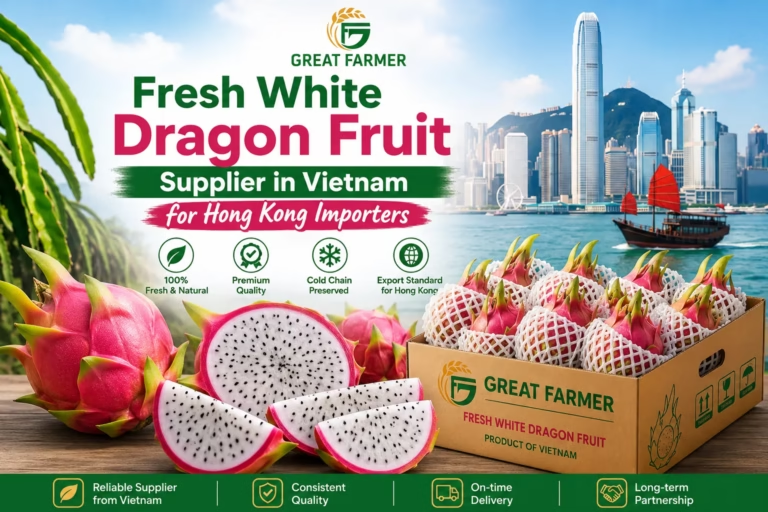
Dragon Fruit: Available in both red-fleshed and white-fleshed varieties. The fruits are large, with firm green bracts and an evenly colored red skin. Vietnamese dragon fruit continues to maintain a strong presence in numerous international markets.
-
Mango: Includes Cat Chu Mango, Cat Hoa Loc Mango, and Keo Mango. These varieties are known for their thick flesh, small seed, rich sweetness, and attractive aroma.
-
Guava: Includes Queen Guava and Taiwanese Guava with white or pink flesh. The fruits are crisp, naturally sweet, low in seeds, and rich in Vitamin C.
-
Banana: Includes tissue-cultured Laba Bananas and Cavendish Bananas. The fruits are uniform in size, have smooth skins free from blemishes, and meet the stringent quality requirements of international supermarket chains.
3.3 Specialty Root Vegetables (Sweet Potato, Taro, Yam, Jicama, Beetroot)
-
Sweet Potato: Includes Japanese Purple Sweet Potato and Yellow Sweet Potato, both valued for their natural sweetness, soft texture, and smooth skin.
-
Taro & Yam: Large, firm tubers with a soft, starchy texture and no fibrous flesh, meeting the strong market demand in Malaysia and the Middle East.
-
Jicama: Juicy, crisp roots with a naturally sweet flavor and thin skin. Stored under optimal temperature conditions to maintain freshness and crispness throughout transportation.
-
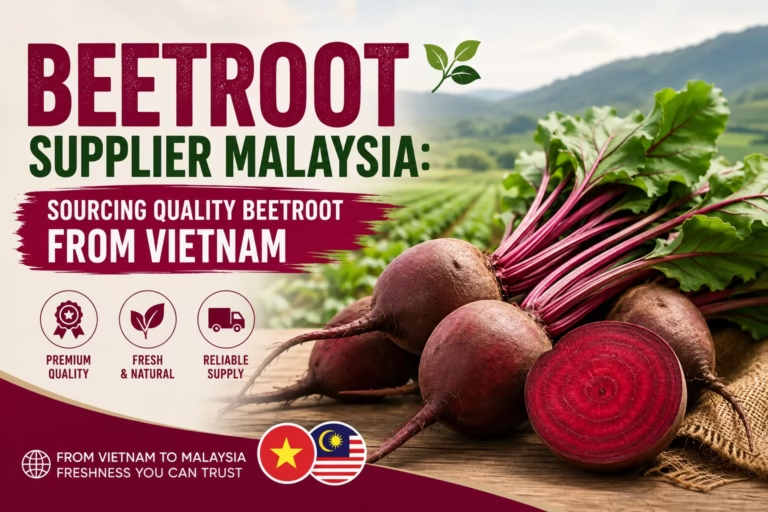
Beetroot: Naturally deep red in color, rich in nutrients, and uniformly round in shape. Primarily exported to Singapore and Hong Kong.
Table 1. Summary of Product Characteristics & Export Seasons of GREAT Farmer’s Fresh Produce
| Product Name | Harvest Season | Key Technical Specifications | Common Packaging Options |
|---|---|---|---|
| Fresh Chili | Year-round | Size: 4–7 cm / 7–9 cm; naturally pungent; free from pests and diseases | 5 kg / 10 kg foam boxes; perforated PE bags |
| Seedless Lime | Year-round | Size: 12–18 fruits/kg; bright green peel; high juice content | 7 kg / 10 kg / 15 kg carton boxes |
| Dragon Fruit | Year-round (Main Season & Off-Season Production) | Weight: 300 g–600 g+; fresh green bracts; uniform red skin | 9 kg / 18 kg carton boxes with foam net sleeves |
| Taro & Yam | July – March (following year) | Uniform tubers weighing 800 g–1.5 kg; washed or brushed clean | 10 kg / 20 kg mesh bags or carton boxes |
| Lemongrass | Year-round | Stalk length: 30–40 cm; white bulb diameter >1.5 cm | 10 kg mesh bags or 10 kg carton boxes |
| Sweet Potato | Year-round | Sizes: S, M, L, XL (100 g–400 g+); smooth skin | 10 kg / 20 kg carton boxes |
| Jicama & Beetroot | November – May | Fresh, firm roots; free from bruises and mechanical damage | Mesh bags or ventilated carton boxes |
4. In-Depth Analysis of Key Global Destinations
4.1 Thailand Market
-
Main Export Products: Fresh Chili, Fresh Lemongrass, Dragon Fruit, and Mango.
-
Market Characteristics: Thailand’s growing regions experience seasonal gaps that differ from Vietnam’s production cycles. In addition, demand for fresh chili and fresh lemongrass is consistently high due to their essential role in traditional Thai cuisine, particularly dishes such as Tom Yum.
-
GREAT Farmer’s Competitive Advantage: The close geographical proximity between Vietnam and Thailand enables shorter transportation times via sea freight or overland trucking through Laos or Cambodia. This helps fresh chili and lemongrass retain their crisp texture, vibrant appearance, and rich flavor upon delivery to wholesale markets in Bangkok.
4.2 Middle East Market (UAE, Saudi Arabia, Qatar)
-
Main Export Products: Seedless Lime, Dragon Fruit, Taro, Sweet Potato, and Guava.
-
Market Characteristics:
-
The hot climate creates strong year-round demand for seedless limes, which are widely consumed in refreshing beverages.
-
Large Asian and Middle Eastern expatriate communities in the UAE and Saudi Arabia generate substantial demand for taro, sweet potatoes, and fresh chili.
-
-
Technical Requirements: Products must be free from prohibited chemical residues and capable of maintaining quality throughout 12–18 days of refrigerated sea transportation.
4.3 Malaysia Market
-
Main Export Products: Taro, Yam, Fresh Chili, Fresh Lemongrass, Seedless Lime, and Jicama.
-
Market Characteristics: The food and beverage (F&B) industry, along with traditional markets in Kuala Lumpur, Penang, and Johor Bahru, consumes large volumes of root vegetables such as taro and yam, as well as fresh herbs and spices including chili and lemongrass, for curries and other local dishes.
-
GREAT Farmer’s Strategy: The company ensures a stable supply with consistent volume and uniform root size, enabling Malaysian wholesalers to efficiently distribute products through their retail networks.
4.4 Singapore Market
-
Main Export Products: Bell Pepper, Beetroot, Seedless Lime, Dragon Fruit, Guava, and Fresh Mango.
-
Market Characteristics: Singaporean consumers are willing to pay premium prices for fresh produce that meets high food safety standards, offers full traceability, and is presented in attractive packaging.
-
GREAT Farmer’s Capabilities: All shipments exported to Singapore are fully traceable to VietGAP- or GlobalG.A.P.-certified agricultural cooperatives. Each shipment undergoes strict pesticide residue testing before being loaded onto air freight or refrigerated (reefer) containers.
4.5 Hong Kong Market
-
Main Export Products: Dragon Fruit (Red-Fleshed and White-Fleshed), Mango, Fresh Banana, Jicama, and Sweet Potato.
-
Market Characteristics: Consumers in Hong Kong favor tropical fruits with auspicious colors such as the vibrant red skin of dragon fruit naturally sweet flavors, and an attractive appearance suitable for premium consumption and gift-giving.
-
Competitive Advantage: Through direct partnerships with farmers in the Mekong Delta, GREAT Farmer is able to coordinate harvesting and transportation efficiently, ensuring that dragon fruit and mangoes maintain their exceptional freshness, vibrant green bracts, and premium appearance upon arrival on retail shelves in Hong Kong.
Table 2. Comparison of Standards & Growth Potential Across Great Farmer Export Markets
| Destination Market | Main Product Demand | Key Technical & Regulatory Requirements | Transportation Method | Growth Potential |
|---|---|---|---|---|
| Thailand | Fresh Chili, Fresh Lemongrass, Dragon Fruit, Mango | Phytosanitary Certificate, ASEAN Maximum Residue Limits (MRLs) | Sea Freight / Overland Transportation | High (Seasonal Supply Complementation) |
| Middle East | Seedless Lime, Dragon Fruit, Taro, Fresh Chili | Halal Certification, GSO Standards, Phytosanitary Requirements | Sea Freight (Reefer Containers, 14–18 Days) | Very High (Import-Dependent Market) |
| Malaysia | Taro, Yam, Fresh Chili, Fresh Lemongrass, Jicama | Phytosanitary Requirements, Labeling Regulations | Sea Freight (4–6 Days) | Stable Growth |
| Singapore | Bell Pepper, Beetroot, Seedless Lime, Fresh Fruits | Strict Singapore Food Agency (SFA) Requirements, Zero Tolerance for Non-Compliant Pesticide Residues | Air Freight / Sea Freight | High-Value Market |
| Hong Kong | Dragon Fruit, Mango, Banana, Sweet Potato | Appearance Quality Standards, Phytosanitary Requirements | Sea Freight (3–5 Days) / Air Freight | High (Premium Consumption & Regional Distribution Hub) |
5. Cold Chain Supply Solutions & International Export Standards
For fresh agricultural products, maintaining post-harvest quality depends heavily on proper storage and transportation practices. Therefore, GREAT Farmer collaborates closely with partners throughout the supply chain to implement effective post-harvest handling procedures and Cold Chain Management, helping preserve freshness, minimize product losses, and ensure product quality upon arrival in destination markets.
5.1 Cold Chain Management Process
Harvesting → Cleaning & Pre-cooling → Grading & Packing → Cold Storage → Transportation by Refrigerated Truck/Reefer Container → Export
-
Proper Harvesting: Agricultural products are harvested during the coolest periods of the day early morning or late afternoon to minimize moisture loss caused by high ambient temperatures.
-
Post-Harvest Handling & Pre-cooling: Immediately after harvesting from cooperative farms, the products are transported to the packing facility for cleaning, grading, and pre-cooling to reduce field heat. This process slows the natural ripening and respiration of plant tissues, helping preserve product quality.
-
Product-Specific Storage: Each type of agricultural product is stored under appropriate temperature and humidity conditions to maintain optimal quality throughout storage and transportation.
- Cold Chain Transportation: Depending on the characteristics of each product and the customer’s requirements, shipments are transported by refrigerated trucks or reefer containers, with storage conditions monitored throughout the export journey.
5.2 Compliance with International Export Standards
In addition to maintaining an effective cold chain, GREAT Farmer works with its partners to ensure full compliance with the import requirements of each destination market, including phytosanitary regulations, product traceability, maximum pesticide residue limits (MRLs), food safety standards, packaging specifications, and Certificates of Origin (C/O). These measures help facilitate customs clearance, reduce export risks, and meet the expectations of international business partners.
6. Vision & Benefits for B2B Partners Working with GREAT Farmer
-
Abundant and Stable Year-Round Supply: Through an extensive network of agricultural cooperatives spanning Vietnam from north to south, GREAT Farmer is able to balance production capacity and ensure a reliable supply, even during off-season periods.
-
Competitive Farm-Gate Pricing: By partnering directly with farmers and agricultural cooperatives, GREAT Farmer minimizes intermediary costs, enabling the company to offer highly competitive pricing to importers.
-
100% Pure Freshness: GREAT Farmer is fully committed to supplying only fresh agricultural products, with no frozen products or produce treated with harmful chemical preservatives.
-
Flexible Packaging Solutions (OEM/Private Label): GREAT Farmer provides customized packaging services tailored to each B2B customer’s requirements, including mesh bags, branded carton boxes, perforated PE bags, and private-label packaging.
-
Comprehensive Export Documentation Support: The company provides complete export documentation, including Customs Declarations, Phytosanitary Certificates, Certificates of Origin (C/O), Halal Certificates, and relevant VietGAP or GlobalG.A.P. certifications, depending on the requirements of the destination market.
7. Frequently Asked Questions (FAQs) – Great Farmer Export Markets
Q1: Why does GREAT Farmer focus exclusively on fresh agricultural products instead of frozen or processed products?
Answer: GREAT Farmer has chosen a specialized business approach to deliver the highest nutritional value and natural flavor to end consumers. The fresh produce markets in countries such as Singapore, the UAE, and Hong Kong consistently offer attractive profit margins and strong demand from premium retail chains.
Q2: How does GREAT Farmer control product quality and pesticide residue levels without owning its own farms?
Answer: GREAT Farmer establishes close partnership agreements with agricultural cooperatives and farmers. We deploy agricultural engineers to directly monitor cultivation records, specify the list of permitted fertilizers and crop protection products in accordance with VietGAP and GlobalG.A.P. standards, and conduct independent laboratory testing before each harvest.
Q3: What certifications and export documents are required for Great Farmer Export Markets?
Answer: Depending on the requirements of each destination market and each customer, GREAT Farmer provides all necessary export documents and certifications to comply with applicable import regulations. These include the Phytosanitary Certificate, Certificate of Origin (C/O), as well as commercial documents such as the Commercial Invoice, Packing List, Bill of Lading (B/L), and any other certificates or documentation required by the customer or the regulations of the destination importing country.
Q4: How long does it take to transport fresh produce to markets such as the Middle East or Thailand?
Answer: Shipments to Thailand typically take 2–4 days by sea freight or overland transportation. Shipments to Singapore, Malaysia, and Hong Kong generally require 3–6 days by sea freight. Shipments to the Middle East (UAE) usually take 14–18 days in specialized refrigerated (reefer) containers.
Q5: What is the minimum order quantity (MOQ) for export orders?
Answer: GREAT Farmer offers flexible solutions for B2B partners. The standard MOQ for sea freight is one 20-foot or 40-foot container, with the option to consolidate multiple fresh produce items into a single shipment (Consolidation Cargo). For air freight, the MOQ ranges from 500 kg to 1 metric ton, depending on the product.
8. Conclusion
Throughout its journey toward international growth, the Great Farmer Export Markets have continued to strengthen the reputation of Vietnamese agricultural products across key strategic markets, including Thailand, the Middle East, Malaysia, Singapore, and Hong Kong. With a commitment to supplying 100% fresh produce, free from freezing or processing, together with a sustainable partnership model involving agricultural cooperatives and farmers, GREAT Farmer is proud to be a trusted partner for agricultural importers worldwide.
Are you an international B2B importer, wholesaler, or retail chain looking for a reliable supplier of Fresh Chili, Seedless Lime, Dragon Fruit, Taro, Fresh Lemongrass, Mango, Sweet Potato, and other premium-quality fresh agricultural products that meet export standards?
Contact GREAT Farmer today to receive the most competitive FOB/CIF export quotation and professional advice on the most suitable logistics solution for your shipment.
🌐 Website: www.greatfarmer.com.vn
📞 Phone/WhatsApp: +84 836314437
📧 Email: hoang.nguyen@greatfarmer.com.vn
 Blog & News