
1. Fruit and Vegetable Market 2025: A Historic Industry Milestone
The year 2025 represents a historic milestone for Vietnam’s agricultural sector, particularly for the fruit and vegetable market in 2025, marking a decisive structural shift in the industry’s global positioning. Despite geopolitical uncertainties and macroeconomic volatility, Vietnam’s fruit and vegetable sector has achieved a significant breakthrough, establishing a stronger and more competitive presence within the global agri-food supply chain.
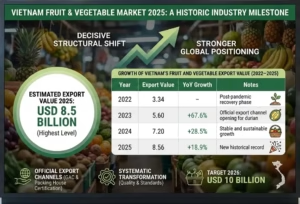
According to the latest data from the General Department of Vietnam Customs and the Vietnam Fruit and Vegetable Association (VINAFRUIT), Vietnam’s fruit and vegetable export value in 2025 is estimated at USD 8.5 billion, the highest level since the country’s integration into the global agricultural trade system. This represents substantial growth compared to USD 7.1 billion in 2024, reflecting strong year-on-year expansion.
This growth is the result of a systematic transformation across the value chain, including improvements in product quality, farming standards, production processes, and market development strategies, rather than short-term market fluctuations. In December 2025 alone, export value reached approximately USD 750 million, providing strong commercial momentum and strategic confidence toward the national export target of USD 10 billion by 2026.
Table 1: Growth of Vietnam’s Fruit and Vegetable Export Value (2022–2025)
| Year | Export Value (USD Billion) | YoY Growth | Notes |
|---|---|---|---|
| 2022 | 3.34 | – | Post-pandemic recovery phase |
| 2023 | 5.60 | +67.6% | Official export channel opening for durian |
| 2024 | 7.20 | +28.5% | Stable and sustainable growth |
| 2025 | 8.56 | +18.9% | New historical record |
The growth of the fruit and vegetable market in 2025 reflects strong and sustainable global demand for Vietnamese agricultural products. In particular, it highlights a strategic structural shift from informal cross-border trade to formal official export channels, accompanied by strict compliance with international standards on growing area codes (GAC) and packing house certification, aligning Vietnam’s supply chain with global market requirements.
2. Detailed Analysis of Vietnam’s “Billion-Dollar” Export Commodities
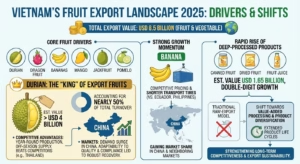
The primary drivers behind the USD 8.5 billion export value are six core fruit categories: durian, dragon fruit, banana, mango, jackfruit, and pomelo. Among them, durian and banana emerged as the two most dominant performers in Vietnam’s export landscape over the past year.
Durian: The “King” of Export Fruits
In 2025, durian continued to consolidate its dominant position, with estimated export value exceeding USD 4 billion, accounting for nearly 50% of total fruit and vegetable export turnover.
-
Competitive advantages: Vietnam benefits from year-round production capacity, particularly its ability to supply off-season durian, creating a significant advantage when major competitors such as Thailand face seasonal supply shortages.
-
Markets: Demand in China surged sharply. Although concerns related to quality control and regulatory compliance emerged in the first half of the year, Vietnamese exporters demonstrated strong adaptability, enabling a robust recovery in export value toward the end of 2025.
Banana and Deep-Processed Products
Alongside durian, bananas have shown strong growth momentum, driven by competitive pricing and significantly shorter transportation times compared to South American competitors such as Ecuador and the Philippines. These logistical and cost advantages have enabled Vietnamese bananas to gain market share in China and neighboring regional markets.
Notably, the fruit and vegetable market in 2025 also witnessed the rapid rise of deep-processed products. The processed fruit and vegetable segment (including canned products, dried products, and juices) reached an estimated value of USD 1.65 billion, recording double-digit growth.
This trend provides clear evidence that Vietnam’s agricultural sector is gradually moving beyond the traditional raw-export model, transitioning toward value-added processing, product diversification, and extended product life cycles, thereby strengthening long-term competitiveness and export sustainability.
3. Dynamics in Key Export Markets
Market diversification has become a critical strategy enabling Vietnam to mitigate risk and maximize export revenues. Below is a detailed analysis of Vietnam’s major trading partners in 2025.
China: Vietnam’s No.1 Strategic Trade Partner
China remains the core strategic pillar of Vietnam’s fruit and vegetable exports.
-
Export value: Reached a record USD 5.5 billion, representing a 19% increase compared to 2024.
-
Market share: Vietnam accounts for 22.5% of China’s total fruit and vegetable import value, ranking second, behind only Thailand.
-
Market trends: Despite its scale and growth potential, the Chinese market is becoming increasingly regulatory-driven and quality-focused. From June 2026, traceability and compliance requirements are expected to be further tightened, particularly for durian and bananas.
This regulatory tightening represents both a structural challenge and a strategic opportunity creating higher entry barriers, but also enabling professionally managed, compliant enterprises to differentiate, scale, and strengthen market leadership in a more standardized trade environment.
United States: High-Potential Market with Significant Entry Barriers
The United States ranks as Vietnam’s second-largest export market, accounting for approximately 6% of total fruit and vegetable export value.
-
Growth: Exports to the U.S. increased by over 30% year-on-year, reaching approximately USD 500 million.
-
Product portfolio: Beyond traditional fruit categories, the list of products approved for U.S. import has expanded to include coconut, pomelo, and deep-processed products, reflecting improved regulatory access and product diversification.
-
Trade balance paradox: Despite rising exports, Vietnam simultaneously recorded a sharp increase in fruit and vegetable imports from the United States, growing by 67% to approximately USD 900 million. Temperate-climate fruits such as cherries, grapes, and U.S. apples are increasingly penetrating the Vietnamese domestic market.
This imbalance highlights a structural trade deficit in the fruit and vegetable sector with the U.S., indicating that while market access and export capacity are improving, the bilateral trade balance remains tilted toward imports, posing long-term strategic considerations for trade policy and industry development.
Other Key Markets: EU, South Korea, and Japan
-
South Korea & Japan: These markets account for approximately 4% and 3% of Vietnam’s export market share, respectively. They are characterized by stringent quality, safety, and traceability standards, but also offer premium pricing, making them strategically important for high-value export positioning.
-
European Union (EU): Growing consumer demand for organic, sustainable, and environmentally responsible food products across the EU is creating significant opportunities for Vietnamese agricultural products that meet GlobalG.A.P. certification and international sustainability standards.
This trend positions Vietnam’s fruit and vegetable sector to move beyond volume-based exports toward high-value, compliance-driven market segments, strengthening long-term competitiveness in developed markets.
Table 2: Structure of Vietnam’s Fruit and Vegetable Export Markets in 2025
| Market | Market Share (%) | Key Characteristics in 2025 |
|---|---|---|
| China | ~65% | 19% growth; increasing requirements for growing area codes and traceability |
| United States | 6% | 30% growth; strict technical and regulatory barriers |
| South Korea | 4% | Stable demand; strong preference for premium fresh and processed fruits |
| Japan | 3% | The most stringent phytosanitary and quarantine regulations |
| Others (EU, ASEAN) | ~22% | High expansion potential driven by Free Trade Agreements (FTAs) |
This market structure highlights Vietnam’s strong dependence on the Chinese market, while also reflecting a gradual diversification strategy toward high-standard markets such as the U.S., Japan, South Korea, and the EU. In parallel, FTA-driven market access continues to create expansion opportunities across ASEAN and European markets, supporting a more balanced and resilient export portfolio.
4. Global Fruit and Vegetable Market Context 2025: Opportunities and Challenges
To gain a comprehensive understanding of Vietnam’s fruit and vegetable market in 2025, it is essential to position it within the broader global context. According to international industry reports, the global fruit and vegetable sector is experiencing a phase of strong structural growth, and is increasingly recognized as one of the most resilient and high-growth segments within the global food industry.
Global Market Size and Growth Dynamics
The global fruit and vegetable market is estimated to reach approximately USD 893.5 billion in 2025, rising from USD 735.6 billion in 2024. Looking ahead, market projections indicate that total market value will exceed USD 1.1 trillion by 2032, supported by a compound annual growth rate (CAGR) of 5.2%.
This sustained expansion reflects long-term structural drivers, including changing consumer dietary habits, rising health awareness, population growth, urbanization, and the increasing demand for fresh, nutritious, and sustainably produced food products worldwide.
5. Consumer Trends Shaping the Market in 2025
Vietnam is benefiting significantly from its ability to effectively align with major global consumption trends, positioning its fruit and vegetable sector for sustained international growth:
-
Health and Nutrition: Global consumers are increasingly shifting toward plant-based diets and healthier lifestyles. Vitamin-rich tropical fruits such as dragon fruit, passion fruit, and coconut from Vietnam are gaining strong demand in international markets due to their nutritional value and natural functional benefits.
-
Organic Products: Particularly in Europe (EU) and North America, consumers demonstrate a high willingness to pay premium prices for products with organic certification and sustainability credentials, creating strong opportunities for compliant Vietnamese producers and exporters.
-
Convenience-Oriented Consumption: Fresh-cut products, convenient packaging formats, and dried fruit products are gaining dominance in major urban markets, driven by changing lifestyles, urbanization, and time-constrained consumers.
-
E-commerce and Digital Distribution: The rapid expansion of online fresh food retail platforms in China and the United States is creating new digital distribution channels, opening scalable market access opportunities for Vietnamese exporters and agri-enterprises.
-
Agricultural Technology (AgriTech): The adoption of IoT, drone technology, and AI in farming and supply chain management is no longer optional. These technologies not only enhance productivity and efficiency, but have become critical requirements for traceability, transparency, and regulatory compliance, particularly in high-standard export markets.
6. Challenges from Technical Barriers and Logistics Constraints
Despite the positive outlook of the fruit and vegetable market in 2025, several critical structural challenges and “grey areas” remain that enterprises must carefully address.
Logistics Barriers and Geographic Distance
For markets such as the United States and Europe, logistics costs continue to represent a major structural burden. Long geographic distances make it difficult for Vietnamese fresh fruit to compete on pricing with suppliers from Latin America (Mexico, Peru) and North Africa (Morocco) in these markets.
In this context, post-harvest technology becomes a strategic survival factor critical for extending shelf life, preserving quality, reducing spoilage, and maintaining commercial competitiveness in long-distance export markets.
Increasingly Stringent Technical Standards
-
United States: Since early 2025, the U.S. has tightened regulations on pesticide residue levels and traceability requirements. Weak monitoring systems in certain growing areas in Vietnam pose risks of regulatory warnings, shipment rejections, or temporary import suspensions.
-
China: China is no longer a “low-barrier” market. New traceability regulations scheduled to take effect in June 2026 will represent a major compliance test for Vietnam’s durian and banana exports.
Pressure from Imports in the Domestic Market
While Vietnam continues to expand exports, the domestic market is facing growing pressure from imported fruits. In 2025, Vietnam spent over USD 3 billion on fruit and vegetable imports, reflecting a 24% year-on-year increase.
The rapid influx of fruits from the United States, Australia, and Thailand into the local market is intensifying competition, forcing domestic producers to upgrade quality standards, branding, and value positioning in order to defend market share within Vietnam itself.
7. Outlook for 2026: Advancing Toward the USD 10 Billion Export Target
Looking ahead, the strong growth momentum achieved in 2025 provides a solid foundation for Vietnam’s fruit and vegetable industry to pursue the strategic milestone of USD 10 billion in export value in 2026.
Key Growth Drivers for 2026–2030:
-
Expansion of bilateral protocols: Ongoing negotiations to expand official export protocols for additional products such as fresh coconut and frozen durian to China are expected to unlock substantial new growth potential and market access opportunities.
-
Digitalization of agriculture: The Ministry of Agriculture and Rural Development has issued a decision to pilot a durian traceability system from January 1, 2026 to June 30, 2026. The adoption of QR codes, blockchain technology, and digital farm management systems in growing-area governance will significantly enhance product transparency, traceability, and national brand credibility in global markets.
-
Deep processing as a strategic growth pillar: The share of deep-processed products is projected to continue increasing, helping to reduce seasonal pressure on fresh fruit consumption, stabilize supply-demand cycles, and improve profit margins through value-added production models.
Conclusion
The fruit and vegetable market in 2025 marks a significant stage of structural maturity for Vietnam’s agricultural sector. The USD 8.5 billion export milestone reflects not only growth in scale, but a fundamental transformation from volume-driven expansion to quality-driven development, and from spontaneous production to professional, standardized industry operations.
To sustain this growth trajectory, the key prerequisites for both enterprises and farmers are production integrity and compliance (particularly adherence to growing area codes and traceability standards), bold investment in processing technologies, and adaptive, data-driven market strategies.
Only through this integrated approach can Vietnam’s long-term ambition of becoming a “global food supply hub” and a leading fruit and vegetable exporting nation be achieved in a sustainable and resilient manner.
Are you seeking investment opportunities or strategic partnerships in Vietnam’s fruit and vegetable sector? Follow our upcoming in-depth market reports to stay updated on the latest industry developments, structural shifts, and emerging opportunities.
Contact us:
📞 Phone / WhatsApp: +84 785 017 575 | +84 778 078 134 | +84 033 531 3567
📧 Email: mia@greatfarmer.com.vn | clay@greatfarmer.com.vn | loan@greatfarmer.com.vn
🌐 Website: www.greatfarmer.com.vn
References / Data Sources:
Vietnam’s fruit, vegetable market in 2025: Exports hit record high
Việt Nam’s fruit, vegetable exports hit record in 2025
Fruit and Vegetable Market 2025 Global and European Outlook
Vietnam eyes 8 billion USD in fruit, vegetable export value in 2025
 Blog & News