Taro is one of the few ingredients that has successfully moved from a survival food to a global culinary trend without losing its identity. It does not need elaborate embellishment: its natural color is visually striking, its texture is distinctive, and its flavor is versatile enough to work equally well in both sweet and savory dishes.
You can encounter taro in a modern beverage, in a familiar soup on a Vietnamese family table, or in ceremonial dishes rooted in indigenous cultures. Wherever it appears, taro shares several defining qualities: it is filling, highly adaptable, and rich in practical value.
Yet taro is far more than “just a root vegetable.” How it is selected, processed, and used has a direct impact on its nutritional value, the eating experience, and even food safety. Why do many modern diets favor taro over refined starches? Why can raw taro cause irritation? And what are the common misconceptions that lead people to misjudge this ingredient?
The article “Everything You Need to Know About Taro” does not aim to tell an emotional story. Instead, it focuses on explanation, analysis, and application from the fundamental nature of taro and its real-world benefits to effective ways of using it in everyday meals and in culinary business models.
1. What Is Taro? Origins and Basic Biological Characteristics
1.1. Definition and Scientific Name
Taro is the common English name for Colocasia esculenta, a plant species that thrives in hot, humid climates and belongs to the Araceae family. It is cultivated primarily for its enlarged underground stem, commonly referred to as a corm, while its leaves are also used in certain traditional cuisines.
In Vietnam, khoai môn and khoai sọ are often considered two distinct varieties based on differences in corm size, mucilage content, and texture after cooking. However, under international botanical classification, both are regarded as different varieties or cultivars within the same taro species group.
1.2. Historical Development and Geographic Distribution
Taro is classified among the oldest staple crops ever domesticated by humans. Numerous studies suggest that it was incorporated into agricultural systems at a very early stage, possibly even earlier than several widely consumed cereal grains.
Southeast Asia and the Indian subcontinent are widely regarded as the original centers of taro domestication. From these regions, the plant spread through human migration and trade routes to the Pacific Islands, Africa, and parts of the Mediterranean coast, where it gradually became an indigenous food closely intertwined with local cultures and daily life.
1.3. Identifying Characteristics
-
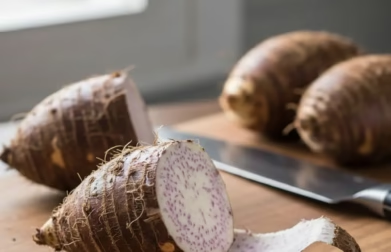
Corm (underground stem): The corm is a swollen underground stem with a dark-colored outer skin and a rough surface, sometimes covered with fine hairs or scale-like textures. The flesh varies in color from white and off-white with purple streaks to deep purple depending on the cultivar and growing conditions.
-
Leaves: Taro leaves are large, heart- or arrow-shaped, and deep green in color. A distinctive feature is their water-repellent surface, which causes water droplets to bead and roll off rather than be absorbed, a phenomenon similar to the well-known “lotus effect.”
-
Flavor profile: When fully cooked, taro develops a rich, creamy mouthfeel with a mild sweetness and a characteristic aroma. Its smooth texture and flavor are often compared to chestnuts, with subtle natural vanilla-like notes.
2. The Nutritional Value of Taro: A Hidden “Treasure”
Many people mistakenly believe that taro is merely a starchy, fattening food. In reality, taro’s nutritional profile is far more complex and valuable than that of potatoes or white rice. It provides a source of clean energy along with a range of essential micronutrients.
Nutritional Composition Table (Per 100 g of cooked taro — Source: SelfMadeHealth)
| Nutrient | Amount | % Daily Value (DV) | Primary Role |
|---|---|---|---|
| Energy | 142 kcal | – | Provides sustained energy |
| Carbohydrates | 35 g | 12% | Primary fuel source for the brain |
| Dietary Fiber | 5 g | 20% | Supports digestion, helps stabilize blood sugar |
| Protein | 1 g | 1% | Muscle building (small amount) |
| Vitamin B6 | 0.331 mg | 25% | Energy metabolism, red blood cell production |
| Vitamin E | 2.93 mg | 20% | Antioxidant, protects cells from oxidative damage |
| Potassium | 484 mg | 14% | Regulates blood pressure, supports heart health |
| Manganese | 0.449 mg | 22% | Supports bone health and metabolic processes |
| Vitamin C | 5 mg | 6% | Enhances immune function |
Expert Insight: One of taro’s most notable strengths is its fiber content, which is roughly twice that of potatoes, along with a significant amount of resistant starch. This type of carbohydrate functions similarly to dietary fiber and does not cause rapid spikes in blood sugar levels.
3. Seven Outstanding Health Benefits of Taro
Why should you include taro in your weekly diet? Below are compelling, science-based reasons:
3.1. Blood Sugar Control and Diabetes Prevention
Although taro is a starchy food, it has a low to moderate glycemic index (GI). Thanks to its high fiber and resistant starch content, taro slows the digestion and absorption of carbohydrates, helping to prevent post-meal insulin spikes. This makes it an excellent alternative carbohydrate source for individuals with type 2 diabetes. (1) (2)
3.2. Reduced Risk of Cardiovascular Disease
Taro is rich in dietary fiber and resistant starch, which help lower cholesterol levels and, in turn, reduce the risk of heart disease. Numerous studies show that higher fiber intake is associated with lower rates of cardiovascular disease and mortality; for every additional 10 grams of fiber consumed per day, the risk of death from heart disease may decrease by up to 17%. (3)
3.3. Supports a Healthy Digestive System
Taro’s high fiber and resistant starch content promotes gut health by nourishing beneficial intestinal bacteria. When fermented in the gut, these compounds produce short-chain fatty acids that help protect the intestinal lining and maintain overall gut integrity. Research indicates that they may reduce intestinal damage and support the prevention of inflammatory bowel conditions and colorectal cancer. (4)
3.4. Supports Natural Weight Management
Looking to lose weight without extreme calorie restriction? Taro is a smart choice. Diets rich in fiber are consistently associated with lower body weight and reduced body fat, as fiber promotes satiety, lowers overall calorie intake, and supports long-term weight management.
The resistant starch in taro provides similar benefits: it helps reduce calorie consumption, lowers post-meal insulin levels, and according to animal studies may reduce overall and abdominal fat by promoting fat oxidation. (5)
3.5. Potential Anti-Cancer Properties
Cancer is closely linked to cellular damage caused by free radicals, which can lead to DNA mutations and tumor development. Taro contains a variety of bioactive compounds such as polyphenols, flavonoids, carotenoids, and notably the lectin tarinthat exhibit potential anti-cancer effects.
Research findings indicate that:
-
Polyphenols derived from taro may inhibit the growth of cancer cells, including breast, colon, and liver cancer cells.
-
Tarin demonstrates immunomodulatory activity and suppresses cancer cell proliferation, showing laboratory effectiveness comparable to certain chemotherapy agents but with significantly lower toxicity.
-
Water-soluble taro extracts may reduce cancer cell invasion and metastasis, inhibit cell migration, and decrease pro-inflammatory factors associated with cancer progression.
These findings suggest that taro is a promising source of natural compounds for the development of supportive cancer therapies, particularly for metastatic breast cancer, with a high safety profile. (6)
4. Distinguishing Taro, Purple Sweet Potato, and Ube
In the culinary world especially in baking and beverage preparation confusion between taro, purple sweet potato, and ube (purple yam) is very common. Understanding their differences helps you choose the right ingredient for each application.
-
Taro
-
Rough, brown outer skin; the flesh is typically off-white with fine purple specks.
-
Turns light purple or grayish-purple when fully cooked.
-
Nutty, creamy flavor with low sweetness and moderate chewiness.
-
Commonly used in savory dishes (soups, stews) as well as bubble tea and desserts.
-
-
Ube (Purple Yam)
-
Dark brown, rougher skin than taro.
-
Vibrant, deep purple flesh.
-
Sweeter than taro, with a stickier and more elastic texture.
-
Primarily used in jams, ice cream, and desserts; especially popular in Filipino cuisine.
-
-
Purple Sweet Potato
-
Thin, smooth skin.
-
Deep purple or purplish-black flesh.
-
The sweetest of the three, with a texture that can be crumbly or chewy depending on the variety.
If you want, I can also convert this section into a comparison table for easier reading or adapt it for SEO, menu descriptions, or product labeling.
-
5. Culinary Applications of Taro: From Tradition to Modern Cuisine
Taro is an exceptionally versatile ingredient. Below are some of the most common and globally recognized ways taro is used in cooking:
5.1. Savory Dishes
-
Taro and Pork Rib Soup (Vietnam): A classic home-style dish. Taro is simmered with pork ribs until tender and crumbly, creating a naturally sweet, rich, and creamy broth, finished with sawtooth coriander (ngò gai) for an aromatic lift.
-
Taro Dumplings (Dim Sum): A smooth taro paste forms a crisp fried exterior around a filling of char siu pork or shrimp. This is a signature appetizer in traditional Chinese restaurants.
-
Duck Cooked with Fermented Tofu (Vịt Nấu Chao): A specialty from Vietnam’s Mekong Delta. Taro is lightly fried before being simmered with duck and fermented tofu, adding body to the broth and delivering a deeply rich, savory flavor.
-
Arbi Masala (India): Taro is stir-fried with bold spices such as cumin, turmeric, and chili powder, resulting in a fragrant and robust vegetarian dish.
5.2. Desserts and Beverages
-
Taro Milk Tea: A globally popular beverage. The creaminess of milk combined with taro’s naturally vanilla-like aroma has made this drink an international favorite.
-
Taro Sweet Soup (Chè Khoai Môn): Diced taro cooked with glutinous rice and thick coconut milk, offering a rich yet balanced sweetness.
-
Taro Mooncake Filling: A smooth, lightly sweet filling with an appealing purple hue, often used as an alternative to traditional mung bean paste in mooncakes.
-
Taro Ice Cream: Known for its soft pastel purple color and distinctively creamy, nutty flavor.
6. Critical Warning: Natural Toxins and Safe Preparation
This is the most important section of the article “Everything You Need to Know About Taro” and one that must not be overlooked.
Why Does Taro Cause Itching?
Raw taro contains a high concentration of calcium oxalate, a compound that forms microscopic, needle-shaped crystals. When these crystals come into contact with the skin or are consumed raw, they can penetrate tissue and cause intense itching, mouth numbness, throat irritation, and swelling.
The “Golden Rules” for Using Taro Safely
-
Never eat taro raw: Taro must be thoroughly cooked before consumption. High heat breaks down calcium oxalate crystals, rendering them harmless.
-
Wear gloves when handling: When peeling taro, wear rubber or plastic gloves to prevent direct contact between taro sap and your skin.
-
Keep hands dry: If gloves are not available, make sure both your hands and the taro are completely dry while peeling. Moisture allows the irritant compounds to spread more rapidly.
-
How to relieve itching: If irritation occurs, warm your hands over gentle heat or wash them with warm salt water mixed with lemon juice or vinegar. The acidity helps neutralize calcium oxalate.
7. How to Choose and Store Taro Properly
Great dishes start with good ingredients selection accounts for at least half of the final quality.
How to Choose High-Quality Taro
-
Weight:
Taro that feels lighter than expected for its size is usually more mature, contains less water, and has a higher starch content resulting in a creamier, more crumbly texture. Heavier corms tend to be waterlogged and may become firm or gummy when cooked. -
Shape:
Choose evenly shaped, rounded corms, ideally resembling the shape of an egg. -
Eyes:
The more visible “eyes” or indentations a corm has, the starchier and more flavorful it tends to be. -
Skin condition:
Avoid taro with dark bruises, signs of rot, or insect damage.
Storage Guidelines
-
Unpeeled taro:
Store in a dry, well-ventilated place away from direct sunlight. Do not refrigerate, as excess moisture can cause spoilage and flavor loss. -
Peeled taro:
If not used immediately, soak briefly in lightly salted water, drain well, then store in an airtight container or zip bag. Keep in the refrigerator for 2–3 days, or freeze for several months.
8. Growing Taro at Home: A Simple Gardening Pleasure
If you enjoy gardening, taro is an excellent choice it is easy to grow, relatively pest-resistant, and highly productive.
-
Soil: Taro prefers loose, fertile, humus-rich soil with good moisture retention. The ideal soil pH ranges from 5.5 to 6.5.
-
Water: This is a water-loving plant. Taro can be grown in flooded fields (similar to rice paddies) or in dry soil with frequent watering.
-
Light: Taro thrives in full sun but can also grow well in partial shade.
-
Harvesting: After approximately 7–10 months (depending on the variety), when the leaves begin to yellow and die back, the corms are mature and ready for harvest.
Conclusion
Taro is truly an overlooked superfood. With its impressive nutritional profile, potential disease-prevention benefits, and irresistibly rich flavor, taro deserves a more regular place in the modern household kitchen.
By understanding what taro is, recognizing its health benefits, and learning how to prepare it safely and deliciously, we hope this article “Everything You Need to Know About Taro” has provided you with a comprehensive and practical perspective. Don’t hesitate to experiment with new taro-based recipes starting today to support the health of both yourself and your family.
Are you ready to start cooking with taro? Begin with a comforting pot of hot taro and pork rib soup, or treat yourself to a homemade taro milk tea this weekend.
Frequently Asked Questions (FAQ) About Taro
1. Does eating taro cause weight gain?
No. Taro is low in fat and rich in dietary fiber, which promotes satiety and supports weight management when prepared properly (boiled or steamed rather than deep-fried).
2. Is taro safe for pregnant women?
Yes, it can be very beneficial. Taro provides folate and iron—two essential nutrients for fetal development and for preventing anemia during pregnancy. However, it must always be thoroughly cooked.
3. Why does my throat still itch after eating boiled taro?
This may occur if the taro was not cooked long enough or at a high enough temperature to fully break down calcium oxalate. Make sure the taro is completely soft and fully cooked before consumption.
4. Are taro leaves edible?
Yes, but with caution. Certain taro varieties have leaf stalks that are commonly used in sour soups or pickled dishes (such as dọc mùng in Vietnamese cuisine). Proper preparation is essential to remove the irritating compounds and ensure safety.
 Blog & News