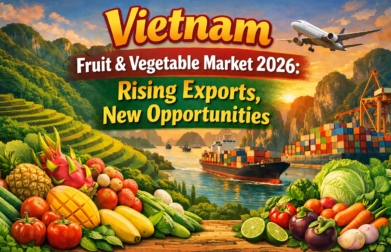
2026 marks a historic turning point as Vietnam Fruit & Vegetable Market 2026 sector officially enters the “billion-dollar era” from the very first quarters of the year. In Q1 2026, Vietnam’s fruit and vegetable export turnover reached a record high of USD 1.48 billion, representing 27% growth compared with the same period in 2025. As of March 20, export value had already reached nearly USD 483 million, up more than 37% from the previous month.
Even more notably, Vietnam was reported to have generated USD 1 billion within the first eight weeks of the year a milestone showing that this growth momentum is no longer just a short-term recovery, but is becoming a clear and sustained upward trend.
If you are looking for a comprehensive view of the Vietnam Fruit & Vegetable Market 2026, the actual figures show that this is not merely growth in numbers, but the result of a transformation in mindset: from raw exports to deep processing and the standardization of global supply chains. So, what are the key factors driving this “explosive” growth, and how is the global market responding to Vietnamese agricultural products?
| Indicator | Key Figures | Implications |
|---|---|---|
| Fruit & vegetable exports (Q1 2026) | Nearly USD 1.48 billion, up 27% YoY | Strong growth right from the beginning of the year |
| Exports as of March 20, 2026 | Nearly USD 483 million | Growth momentum remains solid in March |
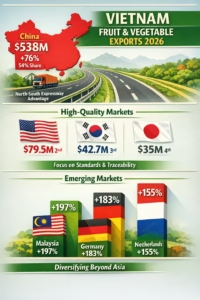
| Exports to China (first 2 months) | Over USD 538 million, up 76% YoY | China continues to be the key market |
| Exports to the United States | Nearly USD 79.5 million | The U.S. remains the second-largest market |
| Fruit & vegetable imports (Q1 2026) | USD 761.4 million, up 25.7% YoY | The sector maintains a trade surplus, but demand for imported raw materials is rising |
| High-growth markets | Malaysia +197%, Germany +183%, Netherlands +155% | Clear signs of expansion beyond Asia |
| Industry target for 2026 | USD 10 billion | An ambitious goal, but increasingly achievable |
3. Supply Chain Standardization: When Barriers Become Competitive Advantages
The European Union (EU) market is well known for its stringent regulations on chemical residues, environmental standards, and labor conditions. In the past, these were significant barriers that discouraged many exporters. However, by 2026, this strictness has effectively become a competitive filter favoring suppliers who can fully comply with these requirements.
As supply chains become more transparent and standardized, Vietnam’s fruit and vegetable sector is gaining access to higher-value markets instead of competing solely on price. This shift is a key driver enabling the industry to confidently pursue its USD 10 billion target this year, further strengthening the global position of Vietnamese produce.
International experts acknowledge that Vietnam’s agricultural supply chain from farmers to processing facilities has achieved a remarkable level of understanding of EU market requirements. While many neighboring countries have struggled to adapt to evolving European regulations, Vietnam has proactively prepared at every stage, from VietGAP and GlobalGAP cultivation standards to fully transparent traceability systems.
4. Infrastructure as a Catalyst: When Expressways Extend the Value of Agricultural Products
Mr. Dang Phuc Nguyen, Secretary General of the Vietnam Fruit and Vegetable Association, pointed out that one of the long-standing weaknesses of agricultural products has been high logistics costs. However, 2026 marks the period when Vietnam’s road infrastructure particularly the North – South Expressway is delivering its full impact.
Shortening transportation time from southern production areas to northern border gates not only reduces spoilage rates but also directly lowers product costs. For perishable goods like fruits and vegetables, “time is money.” Faster delivery to border checkpoints gives Vietnam a clear competitive edge over Thailand, which is currently facing rising logistics costs and longer transit times when exporting to China.
This synchronized investment completes the final piece of the puzzle: Quality – Technology – Logistics. However, the market is not driven by exports alone developments on the import side also offer equally valuable insights.
6. Towards the USD 10 Billion Target: Opportunities and Challenges
Reaching the USD 10 billion milestone will require more than just favorable harvest seasons. The decisive factors will include deep processing, strict quality control, traceability, environmental standards, and robust logistics infrastructure. Vietnam Television has clearly highlighted that product quality, processing technology, and logistics infrastructure are converging to create a major opportunity for Vietnam’s fruit and vegetable sector. In other words, growth in 2026 will be driven by the ability to organize and optimize the value chain not merely by cultivated area or production volume.
The USD 10 billion target for 2026 is ambitious, but entirely achievable if the current momentum is sustained. However, for this growth to be sustainable, the industry cannot rely solely on good harvests. Long-term success will depend on strengthening deep processing capabilities, ensuring consistent quality standards, enhancing traceability systems, meeting environmental requirements, and continuously improving logistics efficiency.
Ultimately, the trajectory of Vietnam’s fruit and vegetable sector will be defined by how effectively it builds and manages its value chain transforming from a production-driven industry into a value-driven ecosystem.
7. How Should Fruit and Vegetable Enterprises Interpret the 2026 Market?
The 2026 fruit and vegetable market is no longer a game of “having products to sell.” It has shifted to “who is more standardized, faster, and better at control wins.” Based on current data, it is clear that companies investing in processing facilities, raw material zones, export standards, and logistics will hold a significant advantage over those relying on short-term trading. This is a practical conclusion drawn from the strong growth of processed exports and the expansion into demanding markets such as the EU, the United States, Japan, and South Korea.
For exporters, four key strategic directions are emerging: increasing the share of processed products; standardizing growing area documentation and traceability systems; diversifying market portfolios beyond Asia; and optimizing delivery time through more efficient logistics. These initiatives do not deliver results overnight, but they build long-term competitive advantages especially as major markets continue to tighten their standards.
For raw material suppliers, this is also a pivotal moment. As processing factories expand capacity, the demand for high-quality, standardized inputs will rise accordingly. This means that farmers, cooperatives, and growing regions can integrate more deeply into the value chain provided they meet requirements for quality, residue control, and supply consistency.
Therefore, the 2026 market is not only creating export opportunities, but also opening the door for a comprehensive restructuring of the entire fruit and vegetable ecosystem.
8. What Is the Biggest Opportunity for Vietnam’s Fruit and Vegetable Market in 2026?
The greatest opportunity does not lie in a single growth figure, but in the fact that Vietnam is entering a phase of “industry upgrading.” As exports rise, processing capacity expands, markets diversify, and logistics improve, Vietnamese fruits and vegetables have the potential to transition from being a “seasonal supply source” to becoming a “strategic supplier” in the eyes of global importers. This is a critical transformation for any agricultural sector aiming for sustainable development.
For this reason, the 2026 market is worth watching not only for its growth rate, but also for how its structure is evolving. As the share of processed products increases, as markets beyond Asia continue to expand, and as imports supporting processing activities also grow, the narrative of Vietnam’s fruit and vegetable sector is shifting.
It is no longer simply about the traditional cycle of “good harvests and good prices.” Instead, it is becoming a story of national competitiveness where value creation, supply chain control, and global integration define long-term success.
 Blog & News