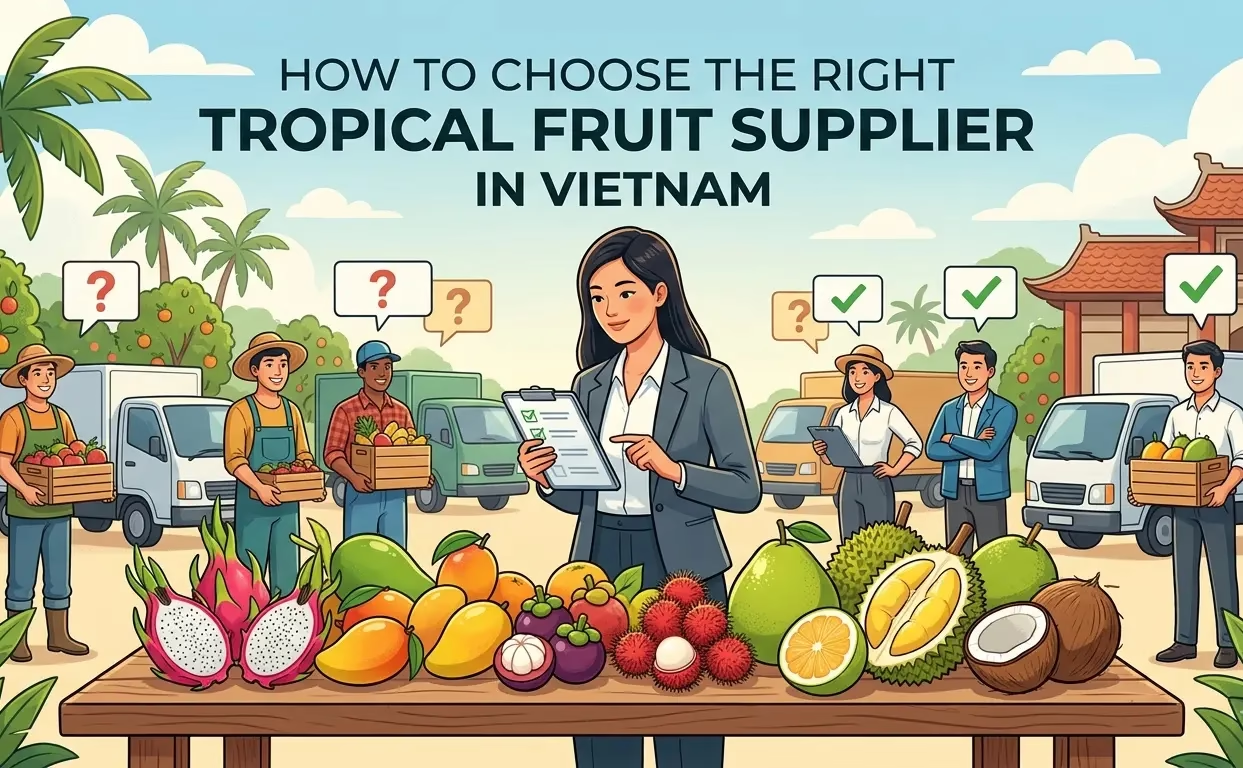
In the context of globalization and the rapidly growing demand for healthy foods, tropical fruits have emerged as one of the most sought-after agricultural commodities worldwide. Vietnam, with its advantages of a tropical monsoon climate, fertile soil, and an extensive coastline, has risen to become one of the world’s leading exporters of tropical fruits. However, for international importers and trading companies, finding a reliable “tropical fruit supplier” in Vietnam remains a challenging task.
Differences in business culture, language barriers, inconsistent quality standards, and risks within the logistics and supply chain can turn a promising deal into a financial setback. This article provides a comprehensive, in-depth, and practical guide to selecting the right tropical fruit supplier in Vietnam—helping your business maximize profitability while minimizing potential risks.
1. Why Choose Vietnam as a Source for Tropical Fruits?
Before diving into how to select the right supplier, it is essential to understand why Vietnam is an ideal destination for tropical fruit importers.
1.1. Diverse Varieties and Favorable Climate
Vietnam’s distinct climate variation from North to South creates ideal conditions for cultivating a wide range of fruits year-round. The North supports the growth of subtropical fruits such as lychee and longan, while the South is known for its abundance of dragon fruit, durian, rambutan, mango, and pomelo. This diversity enables importers to expand and diversify their product portfolios by sourcing from a single country.
1.2. Free Trade Agreements (FTAs)
Vietnam is one of the most proactive countries in participating in free trade agreements. Agreements such as the EVFTA (with the European Union), CPTPP (Comprehensive and Progressive Agreement for Trans-Pacific Partnership), RCEP, and various bilateral agreements help reduce or even eliminate tariffs on agricultural products. This provides a significant pricing advantage for businesses importing fruits from Vietnam, enhancing their competitiveness in global markets.
1.3. Advancements in Agricultural Technology
In recent years, Vietnam’s agricultural sector has undergone remarkable transformation. The adoption of advanced technologies in irrigation, pest management, and especially post-harvest preservation systems (cold chain) has enabled Vietnamese fruits to meet the stringent standards of demanding markets such as the United States, Japan, Australia, and the European Union.
2. Segments of Tropical Fruit Suppliers in Vietnam
To choose the right partner, it is crucial to understand who you are working with. Vietnam’s tropical fruit supply ecosystem is typically divided into four main segments:
-
Farmers / Cooperatives: These are direct sources offering the most competitive prices. However, they often lack export experience, have limited English communication skills, and may not possess the necessary legal documentation to export directly.
-
Local Collectors / Traders: These intermediaries purchase fruits from multiple small-scale farmers. Working with this group carries higher risks in terms of traceability and product quality consistency.
-
Packing Houses / Direct Exporters: This is the most ideal partner segment for B2B importers. They either own farms or maintain strong partnerships with cooperatives, operate standardized packing facilities, understand export procedures, and hold internationally recognized certifications such as GlobalGAP and HACCP.
-
Trading Companies: These companies do not own farms or packing facilities but have extensive sourcing networks and strong commercial expertise. They are a suitable choice if you need to purchase a variety of fruits in smaller quantities within a single mixed container.
3. Core Criteria for Selecting a Reliable Tropical Fruit Supplier
Evaluating a tropical fruit supplier should go far beyond just pricing. Below is a set of internationally recognized criteria that you should apply:
3.1. International Quality Certifications
A professional supplier must demonstrate their capabilities through recognized certifications. These serve as essential “passports” for fruits to be imported into your country:
-
GlobalGAP / VietGAP: Certifications for Good Agricultural Practices, ensuring that fruits are grown safely and comply with pesticide residue limits.
-
HACCP / ISO 22000: Certifications for food safety management systems covering harvesting, sorting, and packing processes.
-
GRASP: A certification focused on social practices, ensuring fair labor conditions and workers’ rights.
-
Organic Certifications: Increasingly in demand in the EU and North American markets (e.g., USDA Organic, EU Organic).
-
Planting Area Code and Packing House Code: Mandatory requirements for exporting to markets such as China, the United States, and Australia.
3.2. Supply Capacity and Consistency
Fruits are highly seasonal products, so it is essential to ensure that your supplier has the capacity to deliver the agreed quantity on time. You should ask key questions such as:
-
What is their total cultivation area (in hectares)?
-
What is their estimated monthly harvest volume?
-
Do they have sufficient cold storage facilities to preserve products during peak seasons?
3.3. Traceability
Today’s end consumers are increasingly concerned about food origin and safety. A reliable supplier must have a clear system whether software-based or manual records to trace each shipment. This includes tracking the product from cultivation (on the farm), harvest date, fertilizer usage, and all the way to the final packaged goods inside the container.
3.4. Logistics Capability and Post-Harvest Handling
Tropical fruits are highly perishable, and the success of any transaction largely depends on post-harvest handling:
-
What methods do they use for pest control? (e.g., Irradiation, Vapor Heat Treatment (VHT), or Fumigation)
-
Is their packaging designed to allow proper ventilation during long sea freight transit?
-
Do they use ethylene absorbers to slow down the ripening process?
4. Seasonal Calendar of Vietnam’s Key Tropical Fruits
Understanding harvest seasons helps importers plan procurement more effectively—securing better prices while avoiding off-season purchases with lower quality and higher costs.
| Fruit (English/Vietnamese) | Key Growing Regions | Peak Season | Recommended Shipping Method |
|---|---|---|---|
| Dragon Fruit | Binh Thuan, Tien Giang, Long An | Year-round | Sea Freight / Air Freight |
| Durian | Tien Giang, Dak Lak, Dong Nai | May – September | Sea Freight (Reefer Container) / Frozen |
| Lychee | Bac Giang, Hai Duong | May – July | Air Freight |
| Passion Fruit | Gia Lai, Lam Dong, Dak Nong | June – December | Sea Freight / Air Freight |
| Mango – Cat Hoa Loc | Dong Thap, Tien Giang, Son La | March – May | Air Freight / Short-transit Sea Freight |
| Pomelo | Ben Tre, Vinh Long | Year-round | Sea Freight (Long shelf life |
| Fresh Coconut | Ben Tre, Tra Vinh | Year-round | Sea Freight |
5. A 6-Step Process to Evaluate and Work with a Tropical Fruit Supplier
To minimize risks, you should follow a strict due diligence process when evaluating potential partners:
Step 1: Online Research and Shortlisting
Use B2B platforms such as Alibaba, TradeKey, or refer to official sources like Vietnam’s Ministry of Industry and Trade and the Vietnam Fruit and Vegetable Association (Vinafruit). Evaluate their website carefully professional suppliers typically have well-structured English websites that clearly display certifications and real images of their facilities.
Step 2: Request Company Profile & Quotation
Contact the supplier to request a quotation (FOB or CIF). At the same time, ask for copies of their quality certifications. Be sure to verify certificate codes through international databases (e.g., checking GlobalGAP codes on the official GlobalGAP website) to ensure authenticity and validity.
Step 3: Assess Communication and Expertise
Through communication channels (Email, WhatsApp, WeChat), evaluate their responsiveness and understanding of your country’s regulatory requirements (SPS – Sanitary and Phytosanitary Measures). A competent exporter will proactively advise you on packaging standards and optimal container temperature settings.
Step 4: Request Samples
Although sending samples via air freight can be costly, this step is essential. It allows you to assess actual quality, Brix level (sweetness), size, and packaging methods. However, keep in mind that samples are often carefully selected and may not fully represent mass production quality.
Step 5: Factory & Farm Audit
For high-value orders, you or a third-party inspection agency (such as SGS, Intertek, or TÜV) should conduct an on-site audit in Vietnam to evaluate:
-
Cleanliness of fruit receiving and sorting areas
-
Performance of pre-cooling systems
-
Quality control (QC) processes along the production line
Step 6: Contract Signing, Payment Terms, and Trial Order
Start with a small trial order (e.g., one 20ft container or an air shipment) to test the logistics chain. In the international sales contract, clearly define:
-
Tolerance: Acceptable weight loss margins
-
Quality Standards: Maximum allowable defect rate at the destination port
-
Payment Terms: Commonly, an irrevocable Letter of Credit (L/C at sight) for initial orders, or Telegraphic Transfer (T/T) with 30% deposit and 70% balance upon receipt of the Bill of Lading copy.
6. Risks to Avoid When Importing Fruits from Vietnam (Red Flags)
During your search for a reliable tropical fruit supplier, watch out for the following warning signs. If encountered, you should seriously reconsider moving forward:
-
Unusually Low Prices: Export-quality fruits that meet international standards and certifications are never “too cheap.” If a supplier offers prices 20–30% lower than the market average, it may indicate substandard products, excessive pesticide residues, or even potential fraud.
-
Refusal to Provide Real-Time Images or Videos: If a supplier hesitates or refuses your request for a live video call (via WhatsApp or Zalo) to show their packing line during a random working day, they may be a “ghost” company or merely a broker without actual facilities.
-
Sudden Changes in Bank Account Details: This is a common form of fraud known as Business Email Compromise (BEC). Never transfer funds to a bank account in a third country or to a personal account that does not match the company’s official details.
-
Lack of Knowledge About the Cold Chain: Tropical fruits require strict temperature control. For example, dragon fruit should be stored at 3°C–5°C, while bananas require 13°C–14°C to avoid chilling injury. If a supplier does not clearly understand and manage these parameters, your shipment is at high risk of spoilage before reaching the destination port.
7. Solving Cross-Border Logistics for Fruit Transportation
Choosing the right supplier is only half the journey; the other half depends entirely on logistics. Professional fruit exporters in Vietnam typically have strong partnerships with experienced freight forwarders to ensure smooth international shipments.
Sea Freight (Reefer Containers): This method is commonly used for fruits with longer shelf life (such as pomelo and coconut) or those transported using Controlled Atmosphere (CA) technology, which helps maintain fruit in a dormant state. Major export ports include Cat Lai Port (Ho Chi Minh City) and Hai Phong Port.
Air Freight: Air transport is ideal for premium fruits with short shelf life and high value (such as lychee exported to Japan or rambutan to the EU). Tan Son Nhat (SGN) and Noi Bai (HAN) are the two main international air cargo gateways in Vietnam.
Packaging: Carton boxes must be made of moisture-resistant materials and designed with proper ventilation holes to allow cold air circulation. Palletizing should be carefully executed to prevent crushing the cartons at the bottom layers, ensuring product integrity throughout transit.
8. Building Long-Term Partnerships with Vietnamese Suppliers
B2B trade especially in the agricultural sector is not about one-off transactions. Building strong, long-term relationships with tropical fruit suppliers in Vietnam can bring significant and sustainable benefits:
-
Market Information Sharing: Keep your suppliers updated on consumer trends in your country. This enables them to adjust packaging specifications or select suitable fruit varieties to better meet market demand.
-
Investment in Farming Areas: For reliable partners, large importers may consider entering into off-take agreements or partially investing in farming infrastructure (such as facilities or residue testing equipment) to secure a stable and exclusive supply of high-quality products.
-
Respectful and Flexible Communication: Business culture in Vietnam places high value on sincerity and personal relationships. Maintaining regular communication and extending greetings during major holidays such as Lunar New Year (Tet) can help resolve potential conflicts more smoothly and efficiently.
Selecting the right tropical fruit supplier in Vietnam is a process that requires a combination of thorough research, a rigorous due diligence approach, and a solid understanding of international trade practices. By gaining deep insights into the market, recognizing key quality standards (such as GlobalGAP and HACCP), understanding seasonal availability, and effectively managing the cold chain, importers can successfully tap into this highly promising tropical agricultural sector.
Vietnam offers not only fruits, but also unique flavors and valuable health benefits to the global market. With proper preparation, Vietnamese suppliers can become reliable long-term partners delivering strong profit margins and supporting the sustainable growth of your business in the global trade landscape.
Great Farmer – Your Comprehensive Tropical Fruit Supply Partner
After evaluating all the critical criteria, Great Farmer stands out as a reliable tropical fruit supplier in Vietnam, fully meeting international standards.
Why Choose Great Farmer?
-
Integrated Supply Chain: Directly connected to farming areas and equipped with modern packing facilities—ensuring optimal freshness and extended shelf life.
-
Strict International Standards: Clearly registered planting area codes, strict MRLs control, and certified with HACCP & ISO 22000.
-
Diverse and Stable Supply: A wide range of fruits including dragon fruit, mango, pomelo, coconut, and more—available year-round.
-
Professional B2B Services: Strong expertise in Incoterms, full documentation support, OEM/Private Label capabilities, and 24/7 order updates.
👉 If you are looking for a trusted tropical fruit export partner from Vietnam, contact Great Farmer today to receive quotations, samples, and tailored import solutions for your market.
Contact us:
📞 Phone/WhatsApp/Line: +84 836314437
📧 Email: hoang.nguyen@greatfarmer.com.vn
🌐 Website: www.greatfarmer.com.vn
 Blog & News