In the context of global agricultural trade, where quality standards and transparency requirements are becoming increasingly stringent, identifying a reliable supply partner has become a critical challenge for importers. Bananas are among the most widely consumed fruits worldwide, and Vietnam is rapidly emerging as a new “powerhouse” on the international banana export landscape.
This article provides a comprehensive, in-depth, and accurate overview of the capabilities of a standard Vietnam Banana Exporter, while also explaining how such exporters build a reputable and sustainable supply chain to successfully penetrate the world’s most demanding markets, including Japan, South Korea, the EU, and the Middle East.
1. The Position of Vietnam Banana Exporters on the Global Agricultural Map
In previous decades, the global banana export market was largely dominated by South American countries such as Ecuador and Colombia, as well as Philippines in the Asian region. However, over the past decade, the rapid rise of Vietnam Banana Exporters has significantly reshaped the global supply demand balance, marking a fundamental shift in the international banana trade landscape.
1.1. Advantages in Natural Conditions and Soil Quality
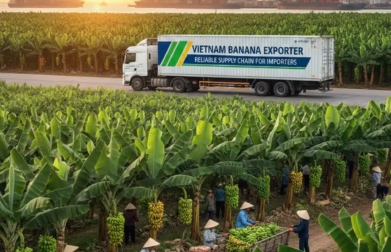
Vietnam is located within the tropical monsoon climate belt and possesses vast areas of fertile agricultural land stretching from north to south. In particular, large-scale banana cultivation zones in Đồng Nai, Tây Ninh, Gia Lai, and the Mekong Delta provide an ideal environment for the development of Cavendish bananas (also known as “chuối già Nam Mỹ”). (1)
The favorable temperature differentials between day and night in the highland regions, combined with the stable thermal conditions in southern Vietnam, enable Vietnamese bananas to achieve high sweetness levels (Brix), thick peels, an attractive golden-yellow color at ripeness, and a longer shelf life key quality attributes highly valued in international markets.
1.2. Production Capacity and Cultivation Scale
Today’s leading Vietnam Banana Exporters no longer operate under fragmented, small-scale collection models. Instead, they have made substantial investments in large-scale plantations spanning thousands of hectares. This strategic transition from traditional agriculture to high-tech and precision agriculture ensures stable, consistent production throughout the year.
The ability to guarantee continuous, year-round supply is one of their most significant competitive advantages, enabling importers to plan their commercial operations and distribution networks with confidence, without the risk of supply disruptions.
1.3. Strategic Geographic Location
Situated at the heart of Southeast Asia, with a long coastline and an increasingly modern network of deep-water seaports such as Cát Lái Port, Cái Mép, Thị Vải Port, and Hải Phòng Port Vietnam enjoys a decisive advantage in transit time to key Asian markets.
Optimized logistics costs further strengthen this position, making Vietnamese export bananas highly competitive in pricing compared to regional competitors, while maintaining efficiency, freshness, and supply chain reliability.
2. Quality Standards: The Commitment of Reputable Vietnam Banana Exporters
For importers, price is not the only determining factor. Product quality and food safety are the true keys to accessing premium supermarkets and high-end retail chains. A professional Vietnam Banana Exporter always places international certifications at the core of all production and operational activities, using them as the guiding principles for sustainable development and global market integration.
2.1. Good Agricultural Practices (GlobalGAP & VietGAP)
For a banana bunch to cross borders and reach international consumers, it must be cultivated under the strictest standards. Most reputable exporters in Vietnam hold GlobalGAP certification, which signifies full compliance with globally recognized agricultural best practices. This includes:
-
Soil and water management: Irrigation water sources and cultivation soils are regularly tested to ensure they are free from heavy metals and harmful microorganisms.
-
Use of agricultural chemicals: The application of pesticides and fertilizers is strictly controlled. Only products approved by the importing country’s regulations are permitted for use.
-
Residue control (MRLs – Maximum Residue Limits): This represents the most critical technical barrier in international trade. Vietnam Banana Exporters must implement sample testing procedures at independent laboratories such as Eurofins and SGS before each harvest cycle, ensuring chemical residues are near zero and fully compliant with the stringent requirements of markets like Japan, South Korea, and the European Union.
This rigorous quality control framework is not only a compliance requirement, but also a strategic foundation that enables Vietnamese banana exporters to compete sustainably in the world’s most demanding markets.
2.2. Social and Environmental Responsibility
Many modern importers particularly those from Europe require their partners to comply with ESG standards (Environmental, Social, and Governance). Export-oriented banana farms in Vietnam are increasingly adopting frameworks such as GRASP (GlobalG.A.P. Risk Assessment on Social Practices) and SMETA audits, ensuring safe, fair, and ethical working conditions for agricultural laborers.
At the same time, they are actively implementing circular farming practices such as using banana stems as organic bio-fertilizer and minimizing plastic waste thereby reducing environmental impact while promoting sustainable, responsible agricultural production.
3. In-Depth Supply Chain Analysis (Reliable Supply Chain): From Farm to Seaport
To answer the question, “Why should you choose a Vietnam Banana Exporter as your strategic partner?”, it is essential to examine their supply chain in detail. A reliable supply chain does not happen by chance—it is the result of a highly synchronized integration of agricultural technology, industrial processing systems, and logistics operations.
This level of coordination transforms banana production from a traditional farming activity into a structured, controlled, and scalable supply system capable of meeting the strict requirements of global markets.
3.1. Pre-Harvesting Stage
Banana quality is determined from the very moment the plant begins to form a bunch. At standard-compliant farms, the following practices are strictly applied:
-
Bunch bagging: As soon as the banana bunch forms, it is covered with specialized protective plastic bags, often treated with biological insect-repellent agents. This process protects the fruit from pests, birds, and adverse weather conditions, ensuring a flawless peel appearance with uniform color and no surface defects.
-
Hand padding and bud removal: Thin foam liners are placed between banana hands to prevent abrasion caused by wind movement and friction. The terminal male bud is removed at the correct stage, allowing the plant to concentrate nutrients on fruit development and quality.
-
Tagging and monitoring: Each banana bunch is labeled with a color-coded time tag. Agricultural engineers use these tags to accurately track the age of the bunch, ensuring harvest at optimal physiological maturity (typically 11–13 weeks, depending on the season), meeting strict standards for fruit diameter, length, and overall uniformity.
These pre-harvest controls form the biological and technical foundation of a high-quality, export-grade banana supply chain.
3.2. Modern Harvesting Process
Unlike traditional shoulder-carrying methods that often cause bruising and physical damage, large-scale Vietnam Banana Exporters implement overhead cableway systems running throughout their plantations.
-
Workers carefully cut each banana bunch and hang it onto the cable hooks.
-
The cable system then smoothly transports the bunches directly from the field to the packing house.
This controlled harvesting and transport process eliminates virtually all risks of mechanical damage, preserving fruit integrity, appearance, and structural quality critical factors for premium export markets.
3.3. Processing and Cleaning
Once the bananas arrive at the packing facility, a fast-paced yet highly controlled processing line begins:
-
De-handing: Skilled workers use specialized curved knives to separate individual hands from the main stalk. Each cut must be clean and precise to avoid damaging the crown tissue, which is critical for preventing decay.
-
Latex removal: The banana hands are immersed in the first clean-water tank to remove soil residues and latex sap from the fruit surface.
-
Alum/food-safe treatment: The bananas are then transferred to a second tank containing a mild alum solution or food-safe sanitizing agents. This process seals the cut surfaces, prevents browning, and inhibits fungal infections particularly crown rot, which can cause stem decay during long-distance transportation.
-
Grading: Experienced workers carefully sort the fruit, removing any bananas with defects (undersized, misshapen, scratched, or spotted). Only export-grade Class A bananas are retained. Larger hands may be divided into clusters of 4–6 fingers, depending on the importer’s packaging specifications.
This meticulous processing and cleaning stage ensures uniform quality, extended shelf life, and compliance with the strict standards of international markets.
3.4. Professional Packaging
Packaging standards are a clear indicator of the professionalism and operational maturity of a Vietnam Banana Exporter. The process follows strict technical protocols:
-
Bananas are lifted from the washing tanks and allowed to drain naturally or dried using air blowers.
-
The cut surfaces of the crowns are treated with antifungal solutions.
-
The hands or clusters are carefully arranged into high-quality cardboard cartons lined with inner PE (Polyethylene) film.
-
Vacuum packing: The PE liner is then partially vacuumed and tightly sealed. This creates a modified atmosphere environment by reducing oxygen levels and increasing CO₂ concentration, effectively placing the fruit into a “dormant” state that delays natural ripening and extends shelf life.
-
The cartons used are high-strength corrugated boxes (typically 5-ply), designed to withstand heavy stacking pressure inside containers, preventing collapse and protecting the fruit from physical stress during transportation.
This professional packaging system plays a critical role in preserving fruit quality, appearance, and freshness throughout long-distance international shipping.
3.5. Cold Chain Logistics System
This is the “heart” of the supply chain. Fresh produce such as bananas requires extremely strict temperature-controlled environments to maintain quality and shelf life.
-
Pre-cooling: After packing, the cartons are immediately transferred into pre-cooling rooms to rapidly remove field heat from the fruit core. If this step is skipped, bananas continue generating internal heat, accelerating premature ripening.
-
Cold storage and container loading: The cartons are palletized and stored in cold rooms or loaded directly into refrigerated containers (reefer containers). Storage and transport temperatures are strictly maintained between 12°C and 14°C. Ventilation is carefully regulated to remove excess ethylene gas.
-
Below 13°C, bananas suffer chilling injury, causing peel discoloration and grey-black damage.
-
Above 14°C, bananas ripen prematurely before reaching the destination port.
-
The professionalism of Vietnam Banana Exporters is further demonstrated through the use of temperature data loggers placed inside containers. Importers can retrieve and analyze this data to verify that temperature stability has been maintained consistently throughout the entire sea voyage.
This fully controlled cold chain system ensures fruit integrity, visual quality, extended shelf life, and compliance with international cold-chain standards for fresh fruit logistics.
4. Standard Technical Specifications of Vietnamese Export Bananas
To help importers clearly visualize and benchmark product quality, below is a table of the basic technical specifications typically provided by a reputable Vietnam Banana Exporter. Please note that these parameters can be flexibly adjusted depending on the specific commercial contract and market requirements.
| Specifications | Quality Standards |
|---|---|
| Variety | Cavendish Banana (Vietnamese Cavendish) |
| Class / Grade | Class A (Premium Quality) |
| Origin | Vietnam (Đồng Nai, Tây Ninh, Gia Lai, etc.) |
| Harvest Color | Green |
| Fruit Length | 17 cm – 22 cm (custom sizing upon buyer request) |
| Calibration / Diameter | 39 – 47 mm |
| Harvest Age | 11 – 13 weeks |
| Weight per Hand | 1.5 kg – 3.5 kg per hand |
| Packing Method | 13.5 kg/carton, PE liner with vacuum packing |
| Loading Capacity | Approx. 1,540 cartons / 40’RF reefer container |
| Storage Temperature | 13.5°C – 14.0°C |
| Shelf Life | 40 – 45 days (under standard cold-chain conditions) |
| Certifications | GlobalGAP, VietGAP, Phytosanitary Certificate, Certificate of Origin (C/O), ISO, HACCP |
5. Key Export Markets of Vietnam Banana Exporters
The strength of a supply chain is most clearly proven through its export markets. Today, Vietnamese bananas are present in multiple countries worldwide—each with distinct standards, regulations, and consumer preferences.
5.1. China Market: The Traditional and Largest Partner
China remains the largest importer of Vietnamese bananas. In the past, imports were mainly conducted through informal cross-border trade with relatively lenient requirements. However, this landscape has changed significantly.
Regulations on growing area codes, packing house codes, and traceability systems are now strictly enforced by Chinese Customs under official bilateral export protocols. Today, Vietnam Banana Exporters ship to China via refrigerated sea containers and cross-border cold-chain trucking, with standardized quality levels fully comparable to shipments destined for high-end international markets.
5.2. Japan and South Korea: The Arena of Perfection
These two markets represent the global benchmark for strict quality standards. While they do not purchase in massive volumes, they are willing to pay premium prices for flawless products.
-
Appearance standards: Bananas must be free from defects, scratches, and blemishes, with bright, uniform peel color.
-
Food safety standards: Strict phytosanitary inspections and residue testing for hundreds of agricultural chemicals are mandatory.
The increasing presence of Vietnamese bananas in major retail systems such as Lotte, Don Quijote, and AEON across Japan and South Korea is the clearest proof of a highly reliable, internationally compliant supply chain.
5.3. Middle East and European Union (EU) Markets
The Middle East—particularly United Arab Emirates and Qatar—is emerging as a high-potential market with strong purchasing power and relatively fewer technical barriers than Europe. However, it places extremely high demands on logistics performance due to long sea transit times (typically 15–20 days).
In contrast, the European Union requires full compliance with sustainability standards, green certifications, and carbon footprint reduction policies. Leading Vietnamese banana exporters are continuously upgrading their post-harvest technology, cold-chain systems, and preservation solutions to successfully conquer these long-haul, high-standard markets.
6. How to Choose a Reputable Vietnam Banana Exporter? (A Practical Guide for Importers)
Among hundreds of companies operating in the agricultural import–export sector, international importers must apply strict filtering criteria to select the right partner. Below are the core evaluation standards:
6.1. On-site inspection of farms and packing facilities
A genuine real supplier will always welcome direct visits to their farms and packing houses. Do not rely solely on emails or websites. Seeing the cableway systems, washing tanks, packing lines, and cold storage facilities firsthand allows you to accurately assess their true scale, technical capacity, and level of professionalism.
6.2. Request a transparent certification and compliance dossier
Request valid GlobalGAP and VietGAP certificates.
In addition, ask for recent laboratory test reports (chemical residue analysis) from their latest export shipments. This is one of the most reliable indicators of long-term quality control stability and compliance consistency.
6.3. Evaluate financial capacity and operational experience
Agricultural export contracts often involve high values and significant risks related to weather, logistics, and transportation. A Vietnam Banana Exporter with strong financial capacity and long-standing industry experience is far more capable of handling crises and compensation scenarios (e.g. vessel delays, schedule disruptions, shipping cancellations) than small intermediary trading companies.
6.4. Traceability system capability
In the digital era, a reliable supply chain must be transparent. A reputable exporter will implement QR code traceability systems on each carton, allowing customs authorities, buyers, and consumers to trace:
-
the exact farm plot,
-
harvest date,
-
cultivation practices,
-
processing and logistics records.
This level of transparency is a hallmark of a truly professional supply chain.
6.5. Commercial flexibility (Incoterms & Payment Terms)
A professional partner demonstrates strong knowledge of international trade law and practices. They can offer flexible delivery terms such as FOB (Free On Board) or CIF (Cost, Insurance and Freight), while applying secure and reliable payment methods such as T/T (Telegraphic Transfer) and irrevocable L/C (Letter of Credit).
This flexibility reflects not only commercial maturity, but also risk management capability and transaction security.This selection framework helps importers distinguish between true exporters with integrated supply chains and pure trading intermediaries, ensuring long-term stability, quality consistency, and strategic partnership value.
7. The Trading Supply Chain Model of Great Farmer
Great Farmer represents a new-generation Vietnam Banana Exporter model operating as a trading company, but structured around an integrated supply-chain–driven trading model, rather than the traditional “buy – sell – ship” trading approach.
Although Great Farmer does not directly own all farming areas, it has built a tightly connected ecosystem in collaboration with:
-
GlobalGAP / VietGAP–certified farms
-
Export-standard packing houses
-
Cold storage systems and reefer container logistics
-
Independent quality inspection laboratories
-
International shipping lines and transport networks
Great Farmer’s operating model is built on three strategic pillars:
7.1. Supply Governance
Instead of sourcing from fragmented spot markets, Great Farmer develops long-term contract farming partnerships, controlling:
-
banana varieties
-
cultivation protocols
-
harvest schedules
-
technical standards
-
processing procedures
→ This ensures stable quality and consistent output for every export shipment.
7.2. Standardized Export Operations
Great Farmer operates through a fully structured flow:
Farm-link → Packing House → Cold Storage → Reefer Container → Export Terminal
This system guarantees:
-
standardized packaging specifications
-
strict cold-chain temperature control
-
inventory management
-
batch-level traceability
-
complete export documentation compliance
7.3. International Trade Management
Great Farmer functions as a central commercial coordination hub, providing importers with:
-
flexible delivery terms: FOB / CIF
-
document management: Phytosanitary Certificate, C/O, COA
-
vessel schedule control
-
logistics risk management
-
international payment coordination (T/T, L/C)
7.4. Strategic Positioning
Within this model, Great Farmer is not merely a “trader,” but operates as:
-
Supply Chain Integrator
-
International Trade Operator
-
Export Coordination Hub
This positioning transforms Great Farmer into a strategic trade partner for global importers, rather than a conventional intermediary trading company delivering long-term value through system integration, risk management, and supply chain governance.
8. Technological Solutions in the Export Banana Supply Chain
To maintain the status of a “Reliable Supply Chain,” Vietnamese exporters are continuously integrating advanced technologies into their operations:
-
IoT Applications (Internet of Things): Sensor systems installed in plantations automatically monitor soil moisture, rainfall levels, and ambient temperature, transmitting real-time data to central control systems. These systems activate automated drip irrigation and fertigation processes, optimizing water and nutrient delivery through pipelines. This ensures uniform plant development, stable growth cycles, and consistent fruit quality across entire plantations.
-
Post-Harvest Technology Management: High-tech MAP (Modified Atmosphere Packaging) films with intelligent respiration control are increasingly used. These advanced materials can extend the fruit’s dormant state by 15–20% longer compared to conventional PE bags, making them highly effective for long-distance sea routes to the Middle East and Europe.
-
Agricultural ERP Systems: Entire operational processes including pesticide application schedules, fertilization programs, harvest planning, and input inventory management are fully digitized through agricultural ERP software. This eliminates human errors from manual record-keeping, enhances traceability, and ensures compliance with international audit and certification requirements.
This technology-driven model transforms the banana export supply chain from a labor-intensive agricultural process into a data-controlled, precision-managed, and digitally governed system, reinforcing reliability, scalability, and long-term competitiveness in global markets.
9. The Future of Vietnam’s Banana Export Industry
Vietnam is entering a golden opportunity to establish a strong national brand identity for bananas on the global market. New-generation free trade agreements such as EVFTA, CPTPP, and RCEP are opening preferential tariff channels, with many product lines benefiting from 0% import duties, creating substantial competitive advantages for Vietnamese exporters.
Over the next 5–10 years, Vietnam Banana Exporters will not be limited to supplying fresh raw bananas alone. The industry is clearly shifting toward deep-processed, value-added products such as freeze-dried bananas, soft-dried bananas, banana powder, and banana purée—significantly increasing the value surplus generated across the supply chain.
Moreover, the development of circular agriculture will transform bananas into a fully green industrial ecosystem, where banana leaves and stems are processed into environmentally friendly textile fibers or biological feed for livestock, maximizing resource utilization and minimizing waste.
This evolution reinforces a powerful message:
Vietnam’s supply chain is not only reliable today — it is structurally sustainable for the future.
It represents a future defined by sustainability, technological integration, value-added processing, and long-term global competitiveness in the international banana industry.
Conclusion
To survive and grow in a global agricultural market marked by intense competition and complex regulatory requirements, the role of an excellent supply-chain partner is indispensable. The synergy between Vietnam’s natural advantages, the dedication of its farmers, and modern management thinking has shaped a new generation of Vietnam Banana Exporters with true global-scale capabilities.
From seedling propagation and cultivation under GlobalGAP standards, to high-tech harvesting systems, professional processing, cold-chain preservation, and advanced logistics—every stage is integrated into a closed, fully synchronized ecosystem (A Reliable Supply Chain).
For global importers, partnering with a reputable Vietnamese banana exporter is not simply a transaction—it is a strategic, long-term investment that delivers sustainability, operational security, and lasting brand value.
Are you an importer, wholesaler, or supermarket chain seeking high-quality fresh bananas, competitive pricing, and stable year-round supply?
Would you like to connect directly with GlobalGAP-certified farm systems in Vietnam to receive the best FOB/CIF quotations for your next shipment?
Contact us today to access verified farming networks, transparent supply chains, and customized commercial solutions so your next banana shipment is not just a purchase, but a strategic partnership built for long-term growth.
Contact us:
📧Email: hoang.nguyen@greatfarmer.com.vn
🌐Website: www.greatfarmer.com.vn
📞Phone/Whatsapp: +84836314437
 Blog & News