1. Purple Yam: From a Common Tuber to a High-Value Phenomenon
Purple yam (also known as ube, Dioscorea alata, or purple yam tuber) is not a modern culinary invention. It has long been part of the daily diet in many tropical countries, where it was traditionally consumed as a staple source of carbohydrates. However, in recent years, this tuber has begun to be viewed from an entirely different perspective: as a nutritionally valuable ingredient with broad commercial potential.
What sets purple yam apart is not merely its visual appeal, but rather a rare combination of characteristics seldom found together in a single agricultural crop: a naturally stable color, a high concentration of antioxidant compounds, ease of processing, and versatility across multiple product categories. As a result, purple yam is now being actively utilized in industries such as beverages, confectionery, functional foods, and nutritional supplements.
This article examines purple yam from a scientific and application-oriented perspective, focusing on its biological origins, core nutritional attributes, and the reasons why it is increasingly regarded as a value-added ingredient that exceeds conventional standards within the modern food supply chain.
2. What Is Purple Yam? The Scientific Basis of Dioscorea alata
To accurately assess the nutritional potential and application value of purple yam, it is essential to clearly identify its biological nature. In practice, purple yam is often confused with purple sweet potato or other purple-colored tubers, despite clear differences in botanical classification, structural characteristics, and nutritional composition.
2.1. Botanical Identification
Purple yam is scientifically known as Dioscorea alata and belongs to the family Dioscoreaceae. This group consists of climbing plants that grow from tubers, fundamentally different from sweet potatoes (Ipomoea batatas), which belong to the Convolvulaceae (morning glory) family. In Vietnam, Dioscorea alata is known by various local names such as khoai mỡ, khoai tím, khoai tía, or khoai vạc. In international markets particularly in the Philippines it is widely recognized under the commercial name ube.
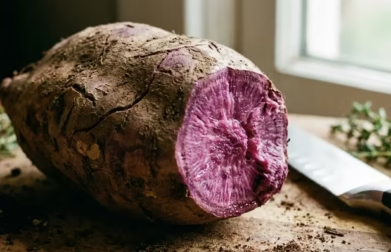
Morphologically, purple yam tubers are typically large and irregular in shape, with a thick, rough outer skin ranging from dark brown to ash gray, sometimes covered with fine rootlets. The interior flesh is the most distinctive feature, displaying colors that range from off-white and pale lavender to deep purple, depending on the cultivar, growing conditions, and the level of anthocyanin pigment accumulation.
2.2. Origin and Distribution
Purple yam originates from tropical Southeast Asia, where hot and humid climatic conditions are highly favorable for the growth of Dioscorea species. For centuries, it has served as a traditional staple crop in Vietnam, the Philippines, Indonesia, India, and several Pacific island regions.
With the rising global demand for natural ingredients rich in nutritional value and natural color, purple yam cultivation has expanded to South America, Africa, and parts of the southern United States. Its strong adaptability, stable yields, and high economic value have positioned Dioscorea alata as a crop of increasing interest within agricultural development programs and modern food supply chains.
The combination of a smooth, elastic starch structure, mild creamy flavor, and naturally stable purple pigmentation has elevated purple yam beyond its role as a traditional tuber, making it a preferred ingredient in contemporary confectionery, beverage, and food processing industries.
3. Nutritional Value: Why Is It Considered “Exceptional Value”?
Purple yam is not only visually appealing it also offers an impressive nutritional profile compared to many other tuber crops. Its key components include complex carbohydrates, dietary fiber, and essential vitamins and minerals that help maintain stable energy levels, support digestive health, regulate blood pressure, and strengthen immune function. In addition, its characteristic purple color is a clear indicator of potent antioxidants such as anthocyanins and vitamin C, which play an important role in protecting cells from free radical–induced damage.
3.1. Nutritional Composition Analysis (per 100 g of cooked purple yam, according to Flavor365 )
| Nutrient | Typical Amount | Primary Function |
|---|---|---|
| Calories | 120–140 kcal | Provides steady energy from complex carbohydrates. |
| Carbohydrates | ~27 g | Primary fuel source to sustain bodily activities. |
| Dietary Fiber | ~4 g | Supports digestion and promotes satiety. |
| Protein | ~1.5 g | Low in quantity, but contributes to tissue repair. |
| Fat | ~0.1 g | Virtually fat-free. |
| Vitamin C | ~17 mg | Antioxidant activity and immune system support. |
| Potassium | ~800+ mg | Helps regulate blood pressure and maintain fluid balance. |
| Vitamin A | ~100–120 IU | Supports vision and immune health. |
| Calcium & Iron | Trace amounts | Contribute to bone health and blood formation. |
3.2. The Secret Behind the Purple Color: Anthocyanins
The most distinctive value of purple yam lies in the natural purple pigmentation of its flesh. This color is derived from anthocyanins a class of flavonoid compounds known for their strong antioxidant properties, which are typically present in high concentrations only in select, nutritionally dense foods.
Nutritional research indicates that purple yam contains significantly higher levels of anthocyanins compared to most commonly consumed vegetables and tubers. These compounds play a critical role in neutralizing free radicals, thereby helping to reduce cellular damage, slow oxidative processes, and lower the risk of chronic diseases associated with oxidative stress, including cardiovascular disease and certain types of cancer.
4. Seven Key Health Benefits of Purple Yam
Incorporating purple yam into your daily diet means more than enjoying a flavorful ingredient it is also a natural way to deliver functional nutrition to the body.
4.1. An Antioxidant Powerhouse
Purple yam is rich in antioxidants, particularly anthocyanins and vitamin C, which help protect cells from damage caused by free radicals factors closely linked to cancer, cardiovascular disease, diabetes, and neurodegenerative disorders.
Vitamin C acts as a potent antioxidant that enhances the body’s overall antioxidant capacity. Anthocyanins (such as cyanidin and peonidin), a class of polyphenols, have been shown in in-vitro and animal studies to slow the growth of certain cancer cells, including colon, lung, and prostate cancers.
Summary: Purple yam is a rich source of anthocyanins and vitamin C, supporting antioxidant defense and potentially reducing cancer risk, although real-world effects depend on intake level. (1)
4.2. Supports Blood Sugar Control
Flavonoids in purple yam may help lower blood glucose levels and improve insulin sensitivity in individuals with type 2 diabetes. Studies suggest that purple yam extracts can reduce oxidative stress, protect insulin-producing cells, decrease appetite, and improve glycemic control primarily based on animal and laboratory research.
In addition, purple yam has a low glycemic index (GI ≈ 24), allowing glucose to be absorbed more slowly, providing sustained energy and minimizing sudden spikes in blood sugar.
Summary: Thanks to its flavonoid content and low GI, purple yam may support blood sugar management, particularly for people with type 2 diabetes. (2)
4.3. Improves Gut Health
Purple yam contributes to digestive health due to its high content of complex carbohydrates and resistant starch—a type of starch that is not fully digested.
Research indicates that resistant starch from purple yam promotes the growth of beneficial gut bacteria such as Bifidobacteria, which support digestion, protect the intestinal lining, and may reduce the risk of conditions such as colorectal cancer, inflammatory bowel disease (IBD), and irritable bowel syndrome (IBS). It also supports the production of beneficial short-chain fatty acids and B vitamins.
Animal studies further suggest anti-inflammatory effects and symptom reduction in colitis, though more human studies are needed to confirm these benefits. (3)
4.4. Helps Regulate Blood Pressure
High blood pressure is a major risk factor for heart attack and stroke. Purple yam may help support healthy blood pressure levels due to its high antioxidant content.
Laboratory studies show that antioxidants in purple yam exhibit effects similar to ACE (angiotensin-converting enzyme) inhibitors, helping to prevent the formation of angiotensin II a compound that raises blood pressure.
Summary: Purple yam extracts demonstrate blood pressure–lowering potential in laboratory studies, though human clinical evidence from dietary intake remains limited. (4)
4.5. May Alleviate Asthma Symptoms
Asthma is a chronic inflammatory airway condition often associated with insufficient antioxidant intake. Research shows that vitamins A and C can reduce both the risk and severity of asthma, with deficiencies linked to higher prevalence.
Purple yam is rich in vitamins A and C, along with other antioxidants, which may contribute to asthma prevention and symptom management.
Summary: Due to its vitamin A and C content, purple yam may help lower asthma risk and support symptom control. (5)
4.6. Supports Weight Management
Thanks to its high fiber and resistant starch content, purple yam promotes prolonged satiety and helps reduce snacking and overeating. This makes it an effective, sustainable strategy for calorie control without compromising energy levels.
4.7. Enhances Vision and Skin Health
Vitamin C supports collagen synthesis, improving skin elasticity and resilience, while modest amounts of vitamin A and antioxidant compounds help protect the eyes against oxidative damage and age-related macular degeneration.
5. Distinguishing “Purple Yam” (Dioscorea alata) from “Purple Sweet Potato” (Ipomoea batatas)
This is a critical section to help consumers avoid confusion when selecting ingredients. Although both tubers share a purple appearance, purple yam and purple sweet potato are botanically and sensorially distinct species, with clear differences in texture, flavor, and functional properties.
Table 2: Comparison Between Purple Yam and Purple Sweet Potato
| Characteristic | Purple Yam (Khoai Mỡ / Ube) | Purple Sweet Potato (Khoai Lang Tím) |
|---|---|---|
| Scientific name | Dioscorea alata | Ipomoea batatas |
| Outer skin | Rough, thick, dark brown to gray, bark-like and relatively hard | Thin, smooth, dark purple or light brown |
| Flesh texture | Slightly mucilaginous when raw; when cooked: elastic, fluffy, mildly starchy with high cohesiveness | Firm, drier, smooth similar to potato |
| Flavor profile | Mildly sweet, nutty, with distinctive vanilla and chestnut-like aroma | Sweeter, flavor similar to common sweet potato |
| Growth habit | Climbing vine; tubers develop deep underground | Creeping vine that spreads along the ground surface |
| Primary applications | Baking, ice cream, desserts, soups (where elasticity is desired), jams (e.g., halaya) | Roasting, boiling, frying, snack production |
Practical Recommendation: If your goal is to prepare traditional Vietnamese canh khoai mỡ or to make authentic, richly elastic ube halaya, purple yam is essential. Using purple sweet potato will not deliver the required level of cohesiveness, nor will it replicate the characteristic flavor profile making it impossible to achieve the authentic texture and taste these dishes demand.
6. Diverse Culinary and Commercial Applications
Purple yam has moved far beyond the home kitchen to become a high-value industrial ingredient.
6.1. Traditional Vietnamese Cuisine
In Vietnam, purple yam is the soul of canh khoai mỡ nấu tôm (purple yam soup with shrimp or minced pork). The tuber is grated or mashed to release its natural viscosity and elasticity, then cooked with fresh shrimp to create a light yet rich, creamy, and deeply satisfying flavor. In addition, crispy fried purple yam fritters are considered a “legendary” street snack.
6.2. The Global Ube Craze
Under the name ube (from the Philippines), purple yam has taken the global dessert scene by storm:
-
Ube Halaya: A thick jam made by slowly cooking purple yam with sugar and milk, enjoyed on its own or spread on bread.
-
Baked Goods & Pastry: Purple yam powder is used in sponge cakes, cheesecakes, and donuts, delivering a striking natural purple color without artificial food dyes.
-
Beverages: Ube latte and purple yam–based milk teas are top-selling items at many major beverage chains.
6.3. Potential in the Food Industry (B2B)
Food and beverage manufacturers are increasingly sourcing pure purple yam powder to:
-
Use as a natural food coloring, replacing synthetic dyes in line with the “clean label” trend.
-
Produce healthy snack products.
-
Develop nutritional powders and plant-based milk alternatives for vegetarian and vegan consumers.
7. How to Select, Store, and Prepare Purple Yam
To fully benefit from purple yam’s value, proper handling is essential.
7.1. How to Choose High-Quality Tubers
-
Shape: Select tubers that are relatively smooth, with fewer fibrous rootlets for easier peeling.
-
Firmness: The tuber should feel heavy and firm, not soft, mushy, or bruised.
-
Cut surface: If pre-cut, choose tubers with deep purple flesh, a dense texture, and no holes or dark spots.
7.2. Proper Storage
-
Unprocessed: Store in a dry, well-ventilated place away from direct sunlight. Do not refrigerate unpeeled tubers, as moisture can cause spoilage and toughening.
-
Processed: If peeled but not fully used, wrap tightly with plastic wrap or vacuum seal. Store in the refrigerator (use within 1–2 days) or in the freezer (up to 1 month).
7.3. Safety Notes During Preparation
Warning: Never consume purple yam raw. In its raw form, it contains calcium oxalate crystals that can cause throat irritation, oral itching, and digestive discomfort. These compounds are completely neutralized by cooking.
When peeling, the yam releases a sticky sap that may cause skin irritation in sensitive individuals. Wearing gloves is recommended.
Soaking peeled yam in lightly salted water or diluted lemon water helps prevent discoloration.
8. Purple Yam Recipes (Family-Friendly Suggestions)
Below are two popular preparations to experience the true flavor of purple yam:
Savory Dish: Southern-Style Vietnamese Purple Yam Soup with Fresh Shrimp
Ingredients:
500 g purple yam, 200 g fresh shrimp, ngo om (rice paddy herb), shallots.
Method:
-
Peel and devein shrimp, lightly mince or crush, and season.
-
Peel purple yam and grate finely (for elasticity) or dice (for chunkier texture).
-
Sauté shallots until fragrant, add shrimp and cook until just firm.
-
Add boiling water.
-
Add purple yam, stirring continuously to prevent clumping and ensure even cooking.
-
Season to taste, turn off heat, and garnish with finely chopped ngo om.
Dessert Beverage: Purple Yam Fresh Milk (Ube Milk)
Ingredients:
200 g steamed purple yam, 200 ml fresh milk, 50 ml sweetened condensed milk, ice cubes.
Method:
-
Mash steamed purple yam until smooth.
-
Gently cook with a small amount of sugar and coconut milk over low heat to form a thick sauce (similar to jam).
-
Spread the purple yam sauce along the inside of a glass to create decorative purple streaks.
-
Add ice, then pour in fresh milk mixed with condensed milk.
-
Stir and enjoy.
Conclusion: The Future of Purple Yam
Purple yam is more than just a food ingredient it represents a refined convergence of flavor, visual appeal, and health benefits. With its high antioxidant content, broad range of applications, and naturally “on-trend” purple color, purple yam заслужably earns a prominent place both in the modern home kitchen and in the product development strategies of food businesses.
Whether you are a home cook seeking to enhance your family’s nutrition or an F&B entrepreneur in search of a breakthrough, high–value ingredient, purple yam delivers truly exceptional value.
Are you ready to bring the power of purple into your menu?
If you are looking for a high-quality, pure purple yam supply or need expert consultation on innovative recipe development, contact Great Farmer today. We are always ready to share our expertise and premium solutions built around this remarkable tuber.
Contact us:
📞 Phone / WhatsApp: +84 785 017 575 | +84 778 078 134 | +84 033 531 3567
📧 Email: mia@greatfarmer.com.vn | clay@greatfarmer.com.vn | loan@greatfarmer.com.vn
🌐 Website: www.greatfarmer.com.vn
 Blog & News