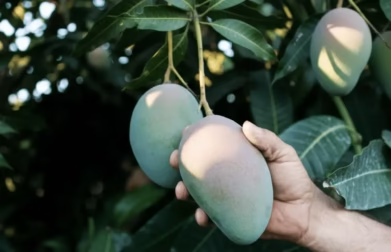
The global fruit market, especially mangoes, constantly presents stringent challenges regarding quality and safety. For mango importers, this fruit is not just a tropical delicacy; it is a multi-billion-dollar global agricultural commodity. With over 4,000 varieties and transported across thousands of miles of ocean, ensuring Mango Quality throughout the supply chain is a challenge for any importer.
As an importer, you face significant risks: a low-quality shipment can result not only in financial loss but also in damaging the hard-earned brand reputation, as well as impacting consumer trust and health. The question is not “Is the mango tasty?” but rather, “Does the mango meet the strict Mango Quality standards of the target market and possess optimal storage and distribution potential?”
This article delves into the professional procedures top importers use to evaluate Mango Quality, providing a detailed Practical Checklist and insightful perspectives based on international standards and real-world experience. The goal is to help suppliers (exporters) and other stakeholders fully understand the “rules of the game” to optimize the supply chain.
1. The Necessity of a Rigorous Inspection Process
To build trust within the food supply chain, the mango quality evaluation process must adhere to the following principles:
-
Varietal Characteristics: Understand the differences in flavor, sweetness, and texture of each mango variety (e.g., Keo, Cat Chu, Cat Hoa Loc).
-
Harvesting and Post-Harvest Techniques: Assess the ideal ripeness, heat treatment methods, and cooling procedures.
-
Transportation Lifecycle: Calculate how ripeness and quality will change throughout the journey from farm to retail shelf.
The evaluation process must be based on established standards, including:
-
Codex Alimentarius Standards (FAO/WHO): General regulations on ripeness and allowable defect tolerances.
-
Importing Country Quality Standards: For example, USDA standards (USA) and EU Regulations (Europe) regarding pesticide residue limits (MRLs).
-
Certification Systems: Requiring food safety certifications such as Global GAP, HACCP, and ISO 22000.
2. Why Mango Quality Evaluation Is the “Golden Key” in the Global Supply Chain
For importers, quality is more than just taste. It is the combination of three factors that determine profitability:
-
Minimizing Post-Harvest Loss: Mangoes are highly perishable. A wrong decision regarding ripeness or handling methods can result in 20–40% of a shipment being damaged before reaching consumers.
-
Brand Positioning and Pricing Power: The premium market only accepts mangoes that meet strict Mango Quality standards. Consistently supplying uniform, defect-free mangoes enables higher negotiation leverage and better pricing.
-
Legal Compliance: Particularly concerning mango pesticide residue limits (MRLs) and phytosanitary requirements in key markets such as the EU, USA, and Japan.
Implementing a professional Practical Checklist for mango inspection is the best financial safeguard for importers.
Summary Table: Importer’s Mango Quality Evaluation Checklist
This is a practical tool you can use immediately, summarizing evaluation criteria according to priority levels:
| No. | Inspection Criteria | Scientific Objective/Indicator | Acceptable Standard (Example) | Supporting Equipment | Priority Level |
|---|---|---|---|---|---|
| 1 | Phytosanitary Inspection | No live pests (insects, eggs, larvae) | Mandatory Phytosanitary Certificate (per importing country requirements) | Visual inspection, VHT/Irradiation records | Critical |
| 2 | Pesticide Residue (MRLs) | Ensure MRLs are below target market limits | Below regulatory MRLs (e.g., max 0.01 mg/kg for Carbendazim in EU) | Lab analysis | Critical |
| 3 | Sweetness (Brix) | Total Soluble Solids (TSS) | Minimum 13 Brix (for varieties like Keo, Cat Chu); 16–18 Brix (for Alphonso) | Refractometer | High |
| 4 | Firmness | Ability to withstand transport and storage | 4–8 kgf (for unripe mangoes, depending on variety); 1–2 kgf (for ripe mangoes) | Penetrometer | High |
| 5 | Color and Ripeness | Pre-harvest maturity level | Uniform ≥70% characteristic color of the variety; no more than 25% fruit fully yellow | USDA color chart / experience | Medium |
| 6 | Surface Defects | Rate of damage (bruises, scars, disease, insect punctures) | Acceptable defect rate ≤5% of total shipment weight (minor defects only) | Random visual inspection | Medium |
| 7 | Stem-End Inspection | Signs of latex leakage or stem-end rot | Stem must be dry, no signs of rot or mold (e.g., Sooty Mold) | Visual inspection | High |
3. PRACTICAL CHECKLIST: 5-Step Mango Quality Evaluation Process
This is a comprehensive inspection process that can be applied directly at the point of origin (Packhouse) or at the destination (Port of Entry).
Step 1: Documentation Check
This check ensures the legality and transparency of the shipment.
-
Phytosanitary Certificate: Confirms that the mangoes are free from pests and diseases.
-
Certificate of Origin: Verifies the source and eligibility for preferential trade agreements.
-
Exporter’s Quality Control (QC) Report: Compares harvest data (TSS, size) with actual shipment.
-
Additional Treatment Certificates: For example, Vapor Heat Treatment (VHT) for markets requiring it.
Step 2: Visual Assessment
Inspect each mango sample to identify and evaluate allowable defect tolerances.
| Criteria | Unacceptable Defect Description | Acceptable Standard |
|---|---|---|
| Color | Completely green (unripe) or dark brown (overripe/damaged) | Uniform color, characteristic of the mango variety |
| Size & Shape | Too small, severely deformed (due to nutrient deficiency or pests) | Uniform, matching the agreed size (e.g., size 8, 9, 10) |
| Skin Condition | Anthracnose (large black spots), Stem End Rot, open insect bites, deep cuts | Minor scratches, light bruising covering less than 10% of surface |
| Latex Residue | Dried sticky latex causing burnt/damaged skin, cannot be cleaned | Absolutely none (must be washed off immediately after harvest) |
Step 3: Sizing and Weight Check
Use calipers and digital scales to ensure uniformity within the shipment.
-
Size Uniformity: Packing standards typically allow a maximum tolerance of ±5 mm in diameter or ±75 g in weight between mangoes in the same box.
-
Count per Box: Randomly check whether the actual number of mangoes matches the labeled count on the carton.
Step 4: Internal Quality Check – Sample Cutting
This is the most crucial step to determine the internal quality of mangoes.
-
Flesh Ripeness: Slice the mango longitudinally to check the flesh color (should be bright yellow or orange-yellow depending on the variety) and texture (free of fiberiness or internal damage).
-
Internal Disorders: Look for Spongy Tissue (soft, damaged internal tissue caused by high temperatures or poor storage) – a serious defect not visible externally.
-
Seed: Seed size should correspond with the fruit’s ripeness. Overripe mangoes may have large seeds and less flesh.
-
Quantitative Measurements: Measure Total Soluble Solids (°Brix) and firmness on the sampled mangoes.
Step 5: Packaging & Logistics Evaluation
Check the product’s storage capability and safety during transport.
-
Cartons: Assess strength (typically require minimum B-Flute or C-Flute compression resistance) and ventilation capacity.
-
Cushioning Materials: Use protective materials (e.g., foam nets, tissue paper) to prevent impact and absorb ethylene.
-
Temperature: Record the core temperature of the product just before loading into the container. The ideal temperature for most tropical mangoes is 10–14°C (depending on variety).
-
Cold Chain Transportation: Require temperature monitoring devices (Data Loggers) in the container to continuously track temperature throughout the journey.
4. Unique Perspective: Analyzing Mango Quality Risks Post-Import
The biggest challenge for importers is maintaining quality during the distribution stage.
4.1. Impact of Ethylene
Mangoes are a fast-ripening (climacteric) fruit, making ethylene control (the ripening hormone) critically important:
-
Solution: Use ethylene absorbers (Ethylene Scrubbers) in cold storage or packaging, and ensure no other ethylene-emitting sources are present in the container (e.g., other ripe fruits).
-
Risk: A container exposed to temperature shocks or high ethylene concentrations can cause the entire shipment to ripen rapidly and simultaneously, resulting in significant losses upon arrival at the warehouse.
4.2. Hidden Defects
Issues not immediately visible during inspection can emerge after 3–5 days, with Stem End Rot being a typical example.
-
Real-World Example: Stem End Rot often develops due to fungal infection entering at the cut stem, becoming clearly visible only after a few days of storage. Professional importers retain a sample batch under cold storage conditions to monitor defect development over 3–4 days.
4.3. Ready-to-Eat Ripeness Evaluation
Some premium importers (typically supermarkets) require mangoes to reach a Ready-to-Eat ripeness level. This standard requires:
-
Firmness: Significantly softer, around 0.5–1.0 kg/cm²
-
Brix Level: Higher, usually 15–18°Brix
To achieve this, suppliers must use a Ripening Chamber with strictly controlled temperature, humidity, and ethylene concentration prior to shipment a process that demands advanced technical expertise and higher costs.
Strategic Partner: Great Farmer – Setting Vietnamese Mango Quality Standards on the Global Map
In the context of increasingly stringent international markets with dense technical barriers, Great Farmer has emerged not just as an agricultural exporter, but as a trusted partner, helping importers solve the toughest challenge: Consistency in Quality.
Why do discerning importers from the EU, USA, and Japan choose Great Farmer? The answer lies in our “Farm-to-Port” quality control process, designed to meet every criterion in the mango evaluation checklist:
-
Mastering GlobalG.A.P Certified Growing Zones:
Instead of sourcing randomly, Great Farmer works directly with key growing zones in the Mekong Delta. With certifications like GlobalG.A.P and MRLs consistently within permitted limits, our products always fall within the safe range for the most demanding markets. -
Advanced Post-Harvest Technology:
Fully aware of risks like Internal Breakdown and fungal infections, Great Farmer applies heat treatment processes (VHT/HWT) and state-of-the-art cold storage technology. The result: mango shipments with optimal firmness, capable of withstanding long transport times while maintaining fresh quality on the shelf. -
Commitment to Uniformity:
With an automated grading system combined with an experienced QC team, we ensure size tolerance always stays within ±5 mm, guaranteeing every box meets Premium Class 1 standards.
Great Farmer’s Promise: “We don’t just sell mangoes; we provide peace of mind. Every mango bearing the Great Farmer brand is proof of the perfect combination between distinctive tropical flavor and international safety standards.”
5. Conclusion: Optimizing the Mango Quality Supply Chain
The evaluation of mango quality by importers is a multi-layered process, combining sensory experience, scientific measurements, and strict regulatory compliance.
For exporters, the key to success is not only growing high-quality mangoes but also:
-
Harvest Management: Ensure harvesting at the correct physiological ripeness (measuring TSS and firmness).
-
Post-Harvest Handling: Control temperature, remove latex residue, and manage fungal infections.
-
Data Transparency: Provide comprehensive MRL test reports and food safety certifications.
Importers view this inspection process as an essential risk management tool, ensuring that every mango reaching consumers meets the highest quality standards, thereby strengthening brand reputation and promoting sustainable trade growth.
Are you ready to eliminate risks and start building a premium, stable mango supply chain?
Contact Great Farmer – the leading expert in exporting mangoes compliant with MRLs and GlobalG.A.P standards. Let us demonstrate our commitment to absolute Mango Quality, starting with your very first shipment.
Contact us:
📞 Phone / WhatsApp: +84 785 017 575 | +84 778 078 134 | +84 033 531 3567
📧 Email: mia@greatfarmer.com.vn | clay@greatfarmer.com.vn | loan@greatfarmer.com.vn
🌐 Website: www.greatfarmer.com.vn
 Blog & News